Monday, 12 September 2011

Unambiguously Pro-Life cover story in this week's Spectator magazine


There's an interesting article on abortion in this week's Spectator. Assistant Editor, Mary Wakefield outs herself as a "religious nutjob" (read: "Catholic") but makes a cogent argument for the the pro-life case without recourse to her religious belief, thereby making it accessible to anyone with a scrap of logic or humanity in them. She points out that "you don’t have to be Catholic, or even Christian, to think it odd to adopt a completely cavalier attitude towards the unborn."

Science is on the side of the pro-life movement. Presumably this is why the pro-abortion movement's rhetoric circles with great sophistry around the false mantra of "choice" (for whom?) and avoids the stark realities of icky science bit. You know, the bit that makes it impossible that the pre-born are not human. The bit that shows what happens to those tiny human beings who don't have a "choice" but who are the victims of somebody else's "choice". This week James Preece makes the point that the Wikipedia account of the abolition of the slave trade does not "tell the charming story of how William Wilberforce suggested abolishing the slave trade and everybody said "what a jolly good idea" but of "a long protracted campaign that had to contend with vested business interests and even claims that those who opposed slavery were traitors in the war against France. It tells of lost vote after lost vote after lost vote." He draws an acute parallel with the campaign to bring an end to abortion. I think that ending abortion is an even more difficult battle as the multifarious vested interests permeate all levels of society on a global scale, and the victims are easier to push "out of sight". The parallel still holds though, and the difficulties in the struggle are no reason to let up the pressure to end the mass slaughter of millions of innocents every year.

There is a personal twist to Mary Wakefield's article. She and her twin brother were born at 29 weeks, she writes, at a time when the upper limit for abortion was 28 weeks. " I was a premature baby, my twin brother and I were born over two months early, at around 29 weeks. We were tiny and I was covered in hair like a spider. As we fought for our lives in incubators, at that time in the mid-Seventies, the abortion limit was just a week earlier: 28 weeks. As we struggled to breathe, elsewhere, a few of our tiny, spidery peer group were being killed. And so I feel this one personally, from the perspective of the voiceless pre-born."

She attacks the "strange and unpleasant consensus which has risen up .... not just on the left, but across the centre too, and throughout Westminster ... from the debate about [Nadine Dorries’s ill-fated abortion bill] ... that abortion is not just a necessary evil, but a jolly good thing. That being pro-choice no longer means just accepting that a woman has a right to decide, but that abortion must be celebrated and all doubters deemed religious nut jobs".

The article describes the commentariat's hysterical reaction: [they said] "first of all, it’s absolute nonsense to say that we need fewer abortions. Second, those who frown on abortion might be awarded contracts. Christians for example." Oh the horror. We have come to a place in human history where believing that killing a child in the womb might not be the best outcome for both mother and child is controversial and would exclude anyone holding it from being involved in counselling women with "crisis pregnancies". Have mercy on us!

Wakefield acknowledges that most Catholics were against the Dorries proposal anyway, but wonders why the simple act of publicly questioning whether it might be a good thing to reduce the abortion rate is so controversial, citing the hounding of Dr Liam Fox for stating that he would support any measure that reduced the number of abortions in the UK: "I think the level is far too high" he said. What ensued was what Wakefield calls a "Fox hunt": "Instead of commending him on an uncharacteristic burst of common sense, a Halloo! went up across Fleet street and spread across the Twittering classes. What on earth does Fox mean, ‘too high?’ What a bigot! What a misogynist!"

I was surprised and pleased to see such an unambiguously pro-life article as the cover story of an influential mainstream publication: Mary Wakefield deserves praise for this. She makes many interesting and logical anti-abortion arguments including the ethical/utilitarian (adoption), politically correct (father's rights), neuroanatomy (if scientists think that dolphins should be "given rights", how much more deserving are unborn humans?), and blunt ("so how do you feel about killing kittens then?").

Wakefield's overarching point is that "it doesn’t make you a bigot to be melancholy about the considered killing of 200,000 embryos a year ... it just makes you human". It's worth going over to Spectator.co.uk and reading it now before it goes into the subscriber's archive.

Thursday, 8 September 2011

Litaniae Beatae Virginis Mariae

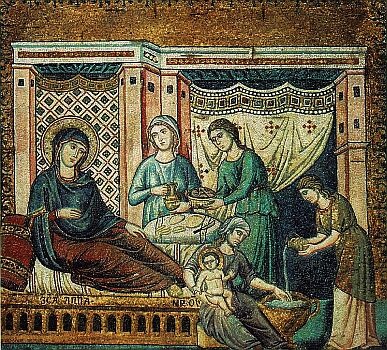
The Nativity of the Blessed Virgin Mary,


Happy Feast Day of Our Lady's Birth!

I found this exerpt from a sermon by St John Damascene (A.D. 676-754/787) thought-provoking reading for today's celebration:

Joachim and Anne were the parents of Mary. Joachim kept as strict a watch over his thoughts as a shepherd over his flock, having them entirely under his control. For the Lord God led him as a sheep, and he wanted for none of the best things. When I say best, let no one think I mean what is commonly acceptable to the multitude, that upon which greedy minds are fixed, the pleasures of life that can neither endure nor make their possessors better, nor confer real strength. They follow the downward course of human life and cease all in a moment, even if they abounded before. Far be it from us to cherish these things, nor is this the portion of those who fear God. But the good things which are a matter of desire to those who possess true knowledge, delighting God, and fruitful to their possessors, namely, virtues, bearing fruit in due season, that is, in eternity, will reward with eternal life those who have laboured worthily and have persevered in their acquisition as far as possible. The labour goes before, eternal happiness follows. Joachim ever shepherded his thoughts. In the place of pastures, dwelling by contemplation on the words of sacred Scripture, made glad on the restful waters of divine grace, withdrawn from foolishness, he walked in the path of justice. And Anne, whose name means grace, was no less a companion in her life than a wife, blessed with all good gifts, though afflicted for a mystical reason with sterility. Grace in very truth remained sterile, not being able to produce fruit in the souls of men. Therefore, men declined from good and degenerated; there was not one of understanding nor one who sought after God. Then His divine goodness, taking pity on the work of His hands, and wishing to save it, put an end to that mystical barrenness, that of holy Anne, I mean, and she gave birth to a child, whose equal had never been created and never can be. The end of barrenness proved clearly that the world's sterility would cease and that the withered trunk would be crowned with vigorous and mystical life. Hence the Mother of our Lord is announced. An angel foretells her birth. It was fitting that in this, too, she, who was to be the human Mother of the one true and living God, should be marked out above every one else. Then she was offered in God's holy temple, and remained there, showing to all a great example of zeal and holiness, withdrawn from frivolous society. When, however, she reached full age and the law required that she should leave the temple, she was entrusted by the priests to Joseph, her bridegroom, as the guardian of her virginity, a steadfast observer of the law from his youth. Mary, the holy and undefiled, went to Joseph, contenting herself with her household matters, and knowing nothing beyond her four walls. In the fulness of time, as the divine apostle says, the angel Gabriel was sent to this true child of God, and saluted her in the words, "Hail, full of grace, the Lord is with thee." Beautiful is the angel's salutation to her who is greater than an angel. He is the bearer of joy to the whole world. She was troubled at his words, not being used to speak with men, for she had resolved to keep her virginity unsullied. She pondered in herself what this greeting might be. Then the angel said to her: "Fear not, Mary. Thou hast found grace before God." In very deed, she who was worthy of grace had found it. She found grace who had done the deeds of race, and had reaped its fulness. She found grace who brought forth the source of grace, and was a rich harvest of grace. She found an abyss of grace who kept undefiled her double virginity, her virginal soul no less spotless than her body; hence her perfect virginity. "Thou shalt bring forth a Son," he said, "and shalt call His name Jesus" (Jesus is interpreted Saviour). "He shall save His people from their sins." What did she, who is true wisdom, reply? She does not imitate our first mother Eve, but rather improves upon her incautiousness, and calling in nature to support her, thus answers the angel: "How is this to be, since I know not man? What you say is impossible, for it goes beyond the natural laws laid down by the Creator. I will not be called a second Eve and disobey the will of my God. If you are not speaking godless things, explain the mystery by saying how it is to be accomplished." Then the messenger of truth answered her: "The Holy Spirit shall come to thee, and the power of the Most High shall overshadow thee. Therefore He who is born to thee shall be called the Son of God." That which is foretold is not subservient to the laws of nature. For God, the Creator of nature, can alter its laws. And she, listening in holy reverence to that sacred name, which she had ever desired, signified her obedience in words full of humility and joy: "Behold the handmaid of the Lord. Be it done unto me according to thy word." 


St Anselm's prayer written  in honour of Our Lady's Nativity


Vouchsafe that I may praise thee, O sacred Virgin; give me strength against thine enemies, and against the enemy of the whole human race. Give me strength humbly to pray to thee. Give me strength to praise thee in prayer with all my powers, through the merits of thy most sacred nativity, which for the entire Christian world was a birth of joy, the hope and solace of its life. 


When thou wast born, O most holy Virgin, then was the world made light. 
Happy is thy stock, holy thy root, and blessed thy fruit, for thou alone as a virgin, filled with the Holy Spirit, didst merit to conceive thy God, as a virgin to bear Thy God, as a virgin to bring Him forth, and after His birth to remain a virgin. Have mercy therefore upon me a sinner, and give me aid, O Lady, so that just as thy nativity, glorious from the seed of Abraham, sprung from the tribe of Juda, illustrious from the stock of David, didst announce joy to the entire world, so may it fill me with true joy and cleanse me from every sin.
 Pray for me, O Virgin most prudent, that the gladsome joys of thy most helpful nativity may put a cloak over all my sins. O holy Mother of God, flowering as the lily, pray to thy sweet Son for me, a wretched sinner. 
Amen.

Mater Amabilis, Ora Pro Nobis!

Prayer and St. Anslem's Sermon from Fisheaters
Maredonian Icon of  the Birth of The Theotokos, from IconStudio 


Tuesday, 6 September 2011

What is "Catholic Coke" doing on the YouCat website?

I don't know who has editorial control of the YOUCAT website, but the inclusion of the "Catholic Coke" video on a page that describes its function thus:
What moves you? Two minutes can flitter away quickly ... But in two minutes, you can also say a lot - and learn a lot! Have a good listen...
 seems utterly inappropriate, not to mention scandalous. Am I missing something or is this really offensive? What is anyone going to "learn" about the Catholic Faith from this video? It makes me feel queasy.


(I'm not sure how to link directly to the embedded video on the YOUCAT page, but have linked to the source on YouTube).


Monday, 5 September 2011

Living the Faith, Radically. Make up your own mind!

For those who weren't at the talk, here it is. Listen and make up your own minds. Listening again, I still think it's great. Oh, and you can play spot the blogger in the audience as well. Extra points if you spot two Guild of Blessed Titus Brandsma bloggers sitting side-by-side.


Rosary


Yesterday we said goodbye to a young Romanian woman who has been living with us for the last four and a half months. She's not Catholic - she's Romanian Orthodox, but (like most young people she knows) very lapsed. Initially she came to Mass with us because we asked her to, but she soon began coming because she wanted to, although not every week. She made Mary's crown for our Parish's Crowning of Mary, and immersed herself in prayer during our EF parish masses. She's also often joined in enthusiastically with our family prayers.

As we said our last goodbyes, I gave her a rosary, a miraculous medal and one of the ACN rosary leaflets. She welled up with tears at the rosary and said that she'd always wanted one, but didn't know where to get one. I think she's going to use it. She said that she's going to try to find a Catholic Church when she gets home.

Please join me in praying that she does.

Friday, 2 September 2011

Campaign for Real Catholic Camping

We've just returned from a camping trip in the North of England where mud is thicker, stickier and, well, muddier than it is down in the soft southern climes that we're used to. It was cold and it rained and the wind howled up on the moors but we were safe and warm and cozy in our very Catholic tent.


Catholic tent?

Well, if you can split digital technology into Catholic and Protestant as Umberto Eco apparently did* then I don't see why you can't have Catholic tents. And if there is such a thing as a Catholic tent, then my lovely bell tent is it. Here's why:

  • Tried and tested - design hasn't changed significantly since the 12th C, and not at all since the 18th. The design is simple and elegant, strong and utterly weatherproof. There are modern versions -- we can call then Episcopalian bell tents if you like -- with nylon guy-ropes (ugh!) instead of hemp, and spring-loaded metal poles instead of wooden ones,  and zips (zips!) instead of dutch lacing, and rubber mud-flaps instead of hessian, but these are about as Catholic as a Barbie Doll in a Biretta  and quite frankly if you aren't going to have the real thing you'd be as well going the whole hog and getting a nylon pop-up tent.
  • It's often the last tent standing: we've been the only tent remaining after severe weather on several occasions over the years, when our fellow campers have blown-away, had plastic (poly-carbon-wotsit) tent-poles snap, had leaky roofs, wind-torn nylon walls and have been forced to pack up, our tent has remained solidly anchored, built to withstand whatever weather it encounters.
  • People are curious / hostile / amused by it at first, but often impressed in the long run. We're often asked "why" we chose this tent over a "normal" one - the answer is easy: it's fast to pitch (one person can do it in 10 minutes, two in 5), utterly weather-proof, has beautiful light inside, is warm in the cold and cool in the warmth, and, for those of a green bent, is utterly ecologically sound - it can always be repaired easily if need be, but if abandoned, it will eventually break down leaving only a few metal eyelets to show that it existed. I have a friend in her late 50s who has a bell tent that her parents acquired when she was 10; they had been given it second hand from a woman who had owned it for at least 30 years before that. My friend still uses her tent several times a year and reckons that her children will be using it for decades once she's past her camping days.


Bell tents are simple yet robust - traditionally they slept up to 13 men each, each sleeping with his feet up to the central pole. They're inexpensive to buy, and last pretty much forever. If you forget to bring your pole, you can do as a friend of mine did and simply cut down a sapling and use it in place of a pole. Bell tents are still used by the army for relief work in trouble spots, particularly camps for displaced persons, as they're robust, yet comfortable enough for a family to live in, if need be, for an extended period. The light that comes through the white canvas is lovely as well. They do have a downside -- they're heavy: you wouldn't want to go hiking with one, but as most people go camping in a car, the downside isn't really relevant.

Oh, and every Catholic tent needs a good Catholic flag! I highly recommend getting a telescopic flagpole to take camping with you, and flying the Papal flag: we've been doing it for years. The supervisor at the top secret location we were camping in said to me on our last morning, "You know, your papal flag has caused no end of consternation this week"  (verbatim). I think he meant interest, not consternation, but what I thought was most curious was that people had *recognised* the flag. Is Lancashire still Catholic at heart?  Apparently he had been asked if there was a "Catholic group" camping, "no, just a Catholic family" he'd told people. Usually we just get hippies hiking past saying "cool flag, man" clearly not having a clue what it is. People fly all sorts of crazy things around their tents when camping - we've got some whirly-dragonflies and a windsock as well as some colourful bunting -- so why not a papal flag as well? Why not give it a try next time you're camping?


+++++++++++++++++++++++++++++++++++++++++++++++++++++++++++


I want some papal bunting too. I noticed that Father Simon Henry has some particularly fine bunting made from miniature papal flags at the entrance of St Catherine Labouré when we traveled across Lancashire for Mass there last Sunday. It was well worth the trek for the Sunday morning Low Latin Mass, lovely to see Fr. Simon again as well as meeting a priest friend of his. We were given a really warm welcome, despite being slightly scruffy, having spent several nights in a muddy field on the moors.


The church is a really good example of how a previously soul-less modernist space can be salvaged with a little thought and some traditionally-minded reordering (or should that be retro-ordering?). The wooden High Altar is particularly fine, and there's a lovely statue of St Catherine Labouré. I wanted to get a closer look at the Tabernacle but it was obscured by the Mass cards; it looked rather beautiful from what I could see and I'm going to keep an eye out next time we're up there.


----------------------------------------


**(btw, I'm so not an Apple person, largely because I find their "hey, are you a cool Apple sort of person like us or some kind dorky loser who uses a PC?" campaign offensive. Not to mention that the last time I upgraded my computer (admittedly 4 years ago so things may have changed), it would have cost twice as much to have the same spec on an Apple as it did on a Dell. I decided that I was happy to be an unhip-PC-using dork and save a grand).