Thursday, 30 June 2011

The Devil has no knees...

I was fascinated by a point made on Fr. Simon Henry's blog: that the Devil is often depicted in art as having no knees. Digging a little further I discovered that
According to Abba Apollo, a desert father who lived about 1,700 years ago, the devil has no knees; he cannot kneel; he cannot adore; he cannot pray; he can only look down his nose in contempt. Being unwilling to bend the knee at the name of Jesus is the essence of evil. (Cf. Is 45:23, Rom 14:11) But when we kneel at Jesus' name, when we bow down in service of others, and when we bend the knee in adoration, we are following in the footsteps of the Magi, we are imitating Blessed Mother Teresa of Calcutta, Saint Maximilian Kolbe, and all the saints and angels in heaven.(from Adoramus.Org)

In France, where we are at the moment, kneeling during Mass, including during the consecration, is far less common than in the UK. Indeed, it is a rare church that even has any sort of provision for kneeling: with rows of chairs, tightly ranged together, a worshipper has to be fairly determined in order to kneel, and it is an uncomfortable choice to make. The norm is to stand (and I have to ask myself whether or not this is supposed to be "reverent standing" in the same way that the shuffling queue up to communion is considered by the CBCEW to be how the "faithful make their sign of reverence in preparation for receiving Communion."). Obviously in the Extraordinary Form there is more kneeling, but there's still less of it than I'm used to in the UK, with "kneeling bits" being truncated and becoming standing or sitting bits at several points in the Mass. It's confusing. It's as though the OF norms in France have permeated the Traditional Rite of the Mass. Of tangential interest: there's not a mantilla to be seen at either form of the Mass.

Over the years I've had to balance a desire not to draw attention to myself in Mass with a growing sense of the importance of Doing The Right Thing (cf. BaraBrith's thoughts on kneeling). In a previous parish in England maintaining this balance meant genuflection before receiving Holy Communion (on the tongue, which was unusual but not contentious in the parish) rather than kneeling: I was specifically asked by the Parish Priest not to kneel to receive the Blessed Sacrament. I did not wear a mantilla either, despite wanting to and feeling that it was the Right Thing to do for many years, because I felt that it would be taken as a sign of "ooooh, look how holy I am" and would arouse hostility. Thus it was a huge relief to move to a parish where the EF was celebrated regularly, and feel able to do the Right Thing without feeling that I was coming across as a beacon of false piety. 

But being in an "EF parish" has strengthened me to some extent. I'm no longer willing to enter a church or chapel where the Blessed Sacrament is reserved without my veil. I'm not willing to stand during the consecration, and wherever possible I receive Our Lord in the Blessed Sacrament on my knees. Yes the mantilla may make me stand out in many parishes, but it's also like a bit of a force-field shielding me from everything but what really matters on the altar. Or perhaps it's a bit more like blinkers on a horse. Either way, it works for me.

I remember talking to a lovely family several years ago who lived in a rural parish in the UK and who had been asked by the local priest to not to genuflect before the Blessed Sacrament at Communion; it had been made clear that kneeling to receive Our Lord was not an option. They ignored the request and continued to genuflect unobtrusively, but were accused of "showing off". In a similar vein, I was dismayed to read a reader's comment on Fr. Finigan's blog about a recent sermon at Westminster Cathedral in which the priest admonished worshippers who knelt for communion as "making a show of [their] piety ... and... making the communion queue too long". There's too much of this about at the moment. 

In response I offer this heartening anecdote: this morning at Mass (in France: Ordinary Form) I was praying before Communion when the priest, on his way down from the sanctuary to distribute Holy Communion, nipped over to where I was kneeling and gave me the Blessed Sacrament there and then on my knees before heading back to distribute communion in the centre aisle. That's the second time it's happened with this particular priest in this church; the first time it really shocked me, it was so unexpected (and we were sitting way off to one side, a couple of rows back, so hardly front and centre). We know him quite well -  he's enthusiastic about the Benedictine reforms - and I'm guessing that he may be making his own point to his congregation in a quieter, more dignified way than whomever's Westminster sermon was referred to above. I'm also willing to bet that our priest here is less than two-thirds the age of the one quoted. 

The future is bright. The future kneels willingly, gratefully, lovingly before Our Lord. 


Tuesday, 28 June 2011

How to cope with a heat-wave? Just say the Latin Mass, obviously!

Apparently we're having a heat-wave ("pic de chaleur") here. To be honest, it's hard to tell the difference, except that it doesn't cool down at all at night. Even though it's technically a heat wave, it's still not as hot as the normal weather in August, so we're coping admirably.

The funny thing here is that although the official temperature might be 32 or 33 degrees, at the meteo station near the coast, it's much hotter in town because the black basalt stones the town is built from retain and release stored heat all day. It's like living in a stone oven. This can make late summer heat - often reported as high 30s  - soar almost 10 degrees higher: and that is unbearable.

The UV index is high as well - 8 or 9 depending on the day and time - which means that the risk of severe sunburn is much higher than we're used to on even the hottest days in South East England. Luckily we live in a tall, narrow street where the houses shade each other and stay relatively cool. So we stay indoors in the cool until later afternoon, then head down to the sea around 5pm, to play and eat dinner on the beach (the water is lovely and warm at this time!), then head home at sunset. It means that our days start and end considerably later than they would in England, although we still manage to head out to Mass in the mornings (when there is one). Formal learning has more or less gone out the window since we've been here, although there have been lots of other sorts of learning opportunities (ever seen anyone catch a large octopus in a classroom?)

So what do the children do all day? Well, left to their own devices they say Mass. In the Extraordinary Form. With great seriousness and reverence. Several times a day. It's 11:15 and we're now on our second Mass of the day. As I started typing this post the strains of Faith of Our Fathers were ringing out onto the narrow street, and earlier a 12th C Alleluia chant resounded through the old town from our attic windows. Given that we live on a sort of fault-line between the Gitane and Arab areas that should raise an eyebrow or two. I used to worry about the children "playing Mass" but have been reassured by more than one sound priest that as long as their play is reverent, which it is, there's no problem. I suppose if we had a TV or hand-held video games they might find something more "normal" to do, but they're happy, I'm happy, and I suspect our local martyred bishop Saint-Simon is rather happy too.

Monday, 27 June 2011

ACN petition & protest march to protect Pakistan's Christians

Some time ago I wrote about the horrendous story of Arshed Masih in Pakistan, a Christian who was tortured and murdered simply for refusing to convert to Islam. The story was reported on Pontifical Institute for Foreign Missions website: the mainstream press tends to pay very little attention to what tend to be seen as "isolated" events. However there is a pattern: there has been a quantifiable increase in attacks on Christians in countries with a Christian minority, and in Pakistan the anti-blasphamy laws are increasingly being used to justify persecution of the Christian minority. ACN reports that 14 attacks on Christians in Pakistan in the last two months alone are directly related to the country's anti-blasphamy laws.


Aid to the Church in Need and the British Pakistani Christian Association have launched a petition asking the British Prime Minister to
"call upon the government of Pakistan to take action to promote justice and equal human rights for all irrespective of faith or any other diversity.
The Blasphemy Law of Pakistan (sections 298A and 295 B&C of the penal code) is being used to settle personal vendettas. We ask that the Blasphemy Law provide universal protection for all faiths, with better auditing of authorities involved with its practical application, or that the law be repealed in its current form"
You can sign the petition here.

Please support the suffering faithful in Pakistan - and encourage friends and family to sign as well.

Aid to the Church in Need will also be joining a Protest March against Pakistan's blasphamy laws. The march is orgnised by the British Pakistani Christian Association and will bring together Christian and Muslim leaders, united against religious injustice.The march will take place in London next Saturday, 2nd July. I won't be in the UK, but would encourage any readers in or around London to consider showing their support.  More information at the ACN website and on the British Pakistani Christian Association blog.

Traditional catechism for children in Paris

Emmanuel Delhoume's blog laments the lack of availability of traditional Catholic catechesis for children and families in France (I think we can concur that the situation is little or no better in the UK) despite there being both a need and a desire for traditional catechetics to be taught at a parish level. His blog announces the start of a new initiative aimed particularly at families in East Paris (12ieme, 13ieme, and 20ieme Arr.) offering fortnightly catechism lessons with a priest from Ecclesia Dei, specifically seeking to prepare children to receive sacraments in the Extraordinary Form of the Roman Rite. As M. Delhoume says "It is our duty as Catholic parents to prepare our children thoroughly for the sacraments and instruct them in the Truths of the Faith". Amen to that!

Please pass on to friends and family in Paris. Interested families can contact Emmanuel Delhoume on 06 67  28 33 38 or edelhoume@voila.fr

Interestingly, one French commentator on this new initiative notes that if Summorum Pontificum is to be implemented fully in parishes, it should go beyond simply offering Sunday Mass in the E.F. but also include a thorough traditional preparation for the Sacraments. I would add that sessions on traditional catechesis and the Truths of the Faith would also be invaluable for adults of my generation, many of whom - myself included - received no real formation in the Faith as children either at school, in our parishs or at home. 

Sunday, 26 June 2011

Notre Dame de l'Agenouillade

Close to where we live for part of the year in France is a little-known Marian shrine devoted to an apparition of Our Lady and a miracle worked through her intersession.

Interior of N.D. de l'Agenouillade, June 2011

The ancient town of Agde (founded by Phocéen traders (ancient Greeks) over 2600 years ago) is built on and of volcanic basalt: it was the striking appearance of this rock that reputedly lead Marco Polo to refer to this then-important seaport as the "Black Pearl of the Mediterranean" - a label still loved by the local tourist board.

Renovated interior - the sanctuary

Around the year 456 the Sanctuary of Notre Dame du Grau, established by the hermit Saint Sever (originally from Syria) was threatened by tumultuous rains which caused the Herault to burst its banks. A strong easterly sea wind meant that sea-water was being forced up-river and compounding the flooding. Just to complicate things, an earthquake happened at the same time (although geologically stable now, in the early Christian era tremors were not uncommon because of the volcanic makeup of the area), creating tidal waves and increasing the terror of the agathois and the monks living in the monastic community established by Saint Sever at the Grau.

Exterior of Notre Dame de l'Agenouillade, Grau d'Agde

As the waters rose, a brave un-named monk from the sanctuary of Notre Dame du Grau knelt and prayed to God, begging for His mercy through the intercession of the Blessed Virgin Mary. Looking up, he saw Our Lady kneeling in prayer on a rock that was still visible above the churning waters, joining her prayers with those of her servant. The waters stopped rising at her feet, and the storm abated. 

The grille covering the rock with the imprint of our Lady's knee

When the waters had receeded the monk found the indentation of Our Blessed Mother's knees in the rock where she had been seen kneeling ("a genouillade" hence "Notre Dame de l'Angenouillade" - literally: "Our Lady of the Kneeling"). The imprinted stone was placed in a chapel, which serves as a shrine, built by Henri de Montmorency in 1583. He also built a monastary and a church which were entrusted to the Capuchin Order. The shrine was, apparently, a pilgrim's stage en-route to Compostella, but I can't find any modern source to confirm this.

The rock on which Our Lady appeared (?)

There is a statue of Our Lady outside the chapel on a large rock which I think is supposed to be the original  site of the apparition, however it's been really badly - garishly - painted ("renovated" by the municipality) and is poorly signed if it is, in fact, the actual site of the apparition. 

An old postcard of the rock of the apparition - with a mother and pram in the foreground!


Chapel/sanctuary pre-renovation - early 20th C


Postcard of N.D. de l'Agenouillade, dated February 1914, sent from Beziers

I have some old photographs of  Notre Dame de l'Agenouillade from before it was "renovated" by the state (my photos, at top of post). Personally, I think it looked better beforehand. Mass is still said here occasionally in the summer. The shrine, which not long ago was in a rural no-mans-land between Agde and the Grau d'Agde is now surrounded by villas and apartment buildings. Despite this, it still retains a cool quietness and an inescapable sense that one is in a sacred space. I like to think that in the same way that our Our Lady joined in prayer with the young monk as the dangerous waters rose, so today she listens to her children in that quiet place, and joins her prayer to our petitions.

Notre Dame de l'Agenouillade, priez pour nous!


New video game, useful for Papal Ninja training?


Cathedral Dodge (subtitle: avoid the extra-extra-extraordinary-somethingorothers)

[Extra points if done with several small children in tow]: 

Can't go straight up the aisle, there's one blocking the priest. OK, left...down the side aisle...  then left again ... then left...NO! There's another one, standing right in the middle of the church for no apparent reason. Smile blankly. Turn left again ... join the correct queue in the centre aisle. Follow shuffling line of worshippers wondering how this can be reverent. Genuflect. Receive Our Lord gratefully. Do a full circuit of the cathedral to get back to your seat 5 feet to the left of where the priest was standing, passing at least a dozen extra-extra-extra-ordinarysomethingorothers en-route. Kneel. Pray thankfully, in part that you don't have to work this hard every Sunday to receive Our Lord from consecrated hands.

Next Sunday we're back at Chapelle Saint Rita. As my 9 year old said: "Mummy, the Latin Mass is so much *simpler*".


Thursday, 23 June 2011

Béziers' best kept secret...

If you like your France à la Peter Mayle, then Béziers isn't the city for you: try Aix or St Remy or some of the pretty Luberon villages instead. There's nothing easy or gentle about Beziers: it rises jagged and arid above the vineyards of the Herault; life on its narrow streets slightly tinged by a shimmering heat haze of madness. It's a Babylon where North African, Gitane, French, Catalan, and Occitane words and dialects colour the local accent. It's beautiful but hard work; invigorating but tiring. In short: not the sort of place you'd expect to find a tranquil haven.

I should come clean here and admit that I'm a glutton for punishment when it comes to cities: many of my favourite places are those that don't instantly reveal their charms, the kind of place you either love or hate. I remember some 15 years ago a colleague at work almost spitting in indignation that anybody could possibly love that hot, noisy, rude city... Béziers. But I do.

Take a look at this link to Google maps: This is Place Garibaldi. Click on StreetView and do a 360' tturn on the spot. Remarkably unremarkable, it's in the heart of a commercial, predominantly Arab district - busy, noisy and dusty: a major arterial route through the centre of town. The narrow side streets have excellent small grocery shops that sell Raz-el-hanout and "maison" tagine spice mixes. Yum. But today we're not here for physical sustenance, rather something longer-lasting.


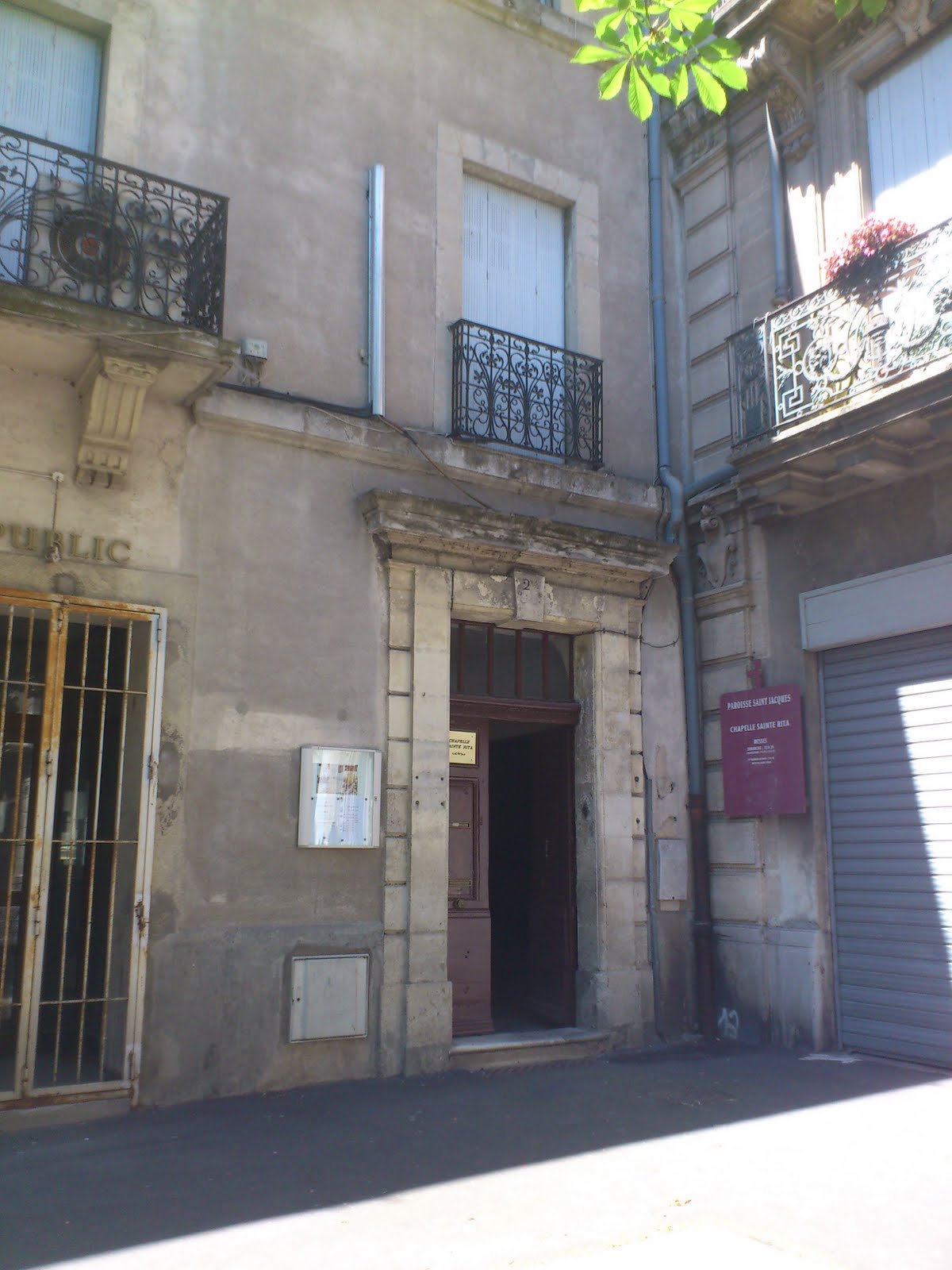
This is the doorway of 2 bis Pl. Garibaldi, Beziers (you can see it on the StreetView link above behind a large blue van that's in the foreground). Even an observant passer-by would spot very little to attract attention; and if such a passer-by were overtaken by curiosity and feel impelled to duck inside this particular doorway to see what he might find, he would discover an entrance hall like a hundred thousand others in French urban buildings, with an unremarkable staircase leading to appartments on the upper floors. Unless, that is, it was a Sunday or Holy Day.

On a Sunday or Holy Day our observer's eye would be led to an open pair of doors at the back of the entrance hall, leading into a large bright vestibule with a tell-tale statue of Saint Rita with votive candles lit before her at one end. If it was a Sunday or Holy Day he might also hear the pure strains of plainsong. Our traveller would have arrived at Chapelle Sainte-Rita: Bezier's best kept secret.


For the past 12 years the Extraordinary Form of the Mass has been prayed here every Sunday morning and every Holy Day. The chapel is devoted to the EF. Years before the Motu Proprio, a traddie-friendly Bishop gave permission for the older form of the Mass to be said here on a regular basis, and a new parish was born. Strictly speaking, it's a "parish within a parish" as the Chapelle is attached to the parish church next to the Cathedral and many parishioners attend their daily Mass there in the Ordinary Form. But what a parish - probably the youngest, most dynamic parish that I can recall: at 41 I felt like an oldie! Large families, new families, teenagers, young couples in their 20s, lots of babies, and a fair sprinkling of older and elderly parishioners as well. I'm used to parishes that pray the Extraordinary Form being far more demographically healthy than the average parish, but this group was positively thriving. The Parish Priest appears to have boundless energy and is wonderfully orthodox, having been ordained in 2005 by the Institut du Christ-Roi Souverain Prêtre, and it is wonderful to see his relationship with both young and old. He also turns out to be a friend of our local Parish Priest (in France) with whom we get on very well - another advocate of the Benedictine reforms. As a family we were welcomed to the Chapelle Sainte-Rita community as though we were long lost parishioners, and instantly invited to events, our eldest son invited to serve the following Sunday. The choir is wonderful, the chapel acoustics lovely. Can you tell that we're delighted?


We've found a true home from home in France, and I heartily recommend any devotees of the old rite looking for Mass in the western Herault to come to Chapelle Sainte-Rita in Beziers (2 Bis, Place Gambetta). There's a hidden pearl of great price behind that innocuous doorway.