Showing posts with label EF. Show all posts

Saturday, 10 November 2012

Lex orandi lex credendi: Pontifical High Mass at Basilico di San Pietro in Vaticano

Originally posted 3/11/2012, thoroughly updated and photographs captioned 10/11/2012
---------------------------------------------------------------------

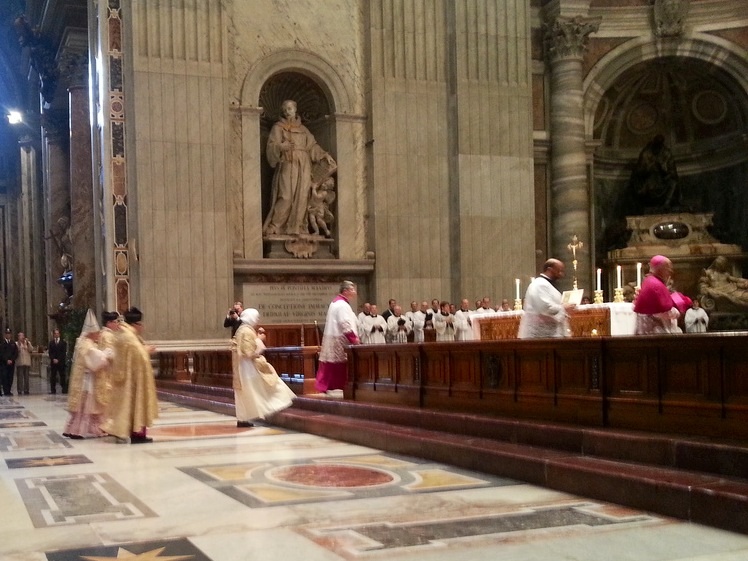
Here are some pictures of today's pilgrimage in thanksgiving for Summorum pontificum organised by the Foederatio Internationalis Una Voce. There have been Masses and traditional devotions organised in the run-up to today, but the Pontifical High Mass (Mass of the Immaculate Heart Of Mary) at the Altar of Saint Peter's Chair celebrated by Cardinal Cañizares Llovera, Prefect of the Congregation for Divine Worship and the Discipline of the Sacraments, is the high point of the Pilgrimage. The Holy Father granted a Plenary Indulgance (under the usual conditions) to the faithful who attended the Mass. 


Following Adoration, the procession of Priests and Pilgrims leaves San Salvatore in Lauro


The Mass was, as expected, beautiful, reverent, and inspired great hope for the future of the traditional liturgy. There were hundreds of pilgrims: I calculated from a quick chair-count from the dome afterwards that, including those standing, there were probably almost a thousand people in the congregation. It was the usual healthy demographic mix that is so common at extraordinary form Masses everywhere: lots of young people - teens, twenties, thirties - in addition to young families and older people. It was - as EF Masses tend to be - racially mixed and with a visible number of disabled people as well. I mention this because the great irony of EF Mass congregations being perfectly "politially correct" in terms of demographic distribution when compared to the average parish, never fails to amuse me. Is anything more inclusive than the Universal Mass in the Universal Church in a universally understood language? I digress...

It feels as though Rome he been taken over by young traddie priests: the Borgo Pio is teeming with them, there were scores (I lost count) on the Sanctuary - it's wonderful and it's the future.  As my husband pointed out, there were very few priests there older than him: the vast majority were in their 20s, 30's and early 40's (poor DH is in his mid 40s).  We have run into several friendly and familiar faces:  the famous  Fr Z, Monseigneur Wasch of the incomparable ICKSP, and Fr Andrew Southwell from St Bedes, Clapham Park but currently clearly enjoying his sabbatical in the Eternal City.

Today started out with Exposition of the Blessed Sacrament at San Salvatore in Lauro followed by a procession through Rome to St Peter's Bascilica for the Pontifical High Mass in the Extraordinary Form celebrated by His Eminence, Antonio, Cardinal Cañizares Llovera, Prefect of the Congregation for Divine Worship. Winding through Rome's narrow streets, four abreast, while singing the Litany of the Saints was, frankly, amazing. We certainly amazed some restaurant patrons who seemed completely freaked out by the presence of a slowly moving procession of singing pilgrims; and that was before the scores of Biretta'd, cassock and cotta'd clergy at the end of the procession passed them by! The traffic was stopped for the procession at major intersections, and the whole of via della conciliazione was closed to allow the pilgrims to process towards St Peter's. I was profoundly grateful that the first memory my children will have of entering St Peter's Basilica will be with a procession of praying, singing pilgrims walking directly up the centre of Piazza San Pietro and through the central doors of the Basilica to the Cathedra Petri and Bernini's amazing creation
 "...designed to display the chair on which, according to ancient tradition, St. Peter sat and taught Roman Christians. Pope Alexander VII had the ivory-covered chair put into the gigantic bronze cathedra, with the statues of the Doctors of the Church, St. Ambrose and St. Augustine of the Roman Church and St. Athanasius and St. John Chrysostom of the Greek Church. The religious significance is extremely clear. The Doctors of the Church were always consistent with Peter's teachings as they expounded theological doctrine.
The gospel does not change because the Holy Spirit, portrayed as a dove flies along the span of the centuries, assisting and accompanying its church. The chair or cathedra of Peter symbolizes the perpetual continuity of the doctrine and its promise of infallibility. It triumphed over all heresies throughout the centuries." 
[from StPetersBasilica.org, emphasis mine)
 
.


 It's been a long but spiritually nourishing day. I'm profoundly grateful to the Holy Father Pope Benedict XVI for Summorum Pontificum as participation in the Extraordinary Form of the Mass has brought many graces to our family - and it was evident today that we weren't the only ones. I spoke to pilgrims who'd come from Brazil to thank the Holy Father and show their fidelity to him. There I was thinking that we'd done well to get four young children to Rome from SE England; I was humbled by what I heard today: young and fit, our journey has been s doddle in comparison to so many who came from around the world.


I prayed for my readers, for other Catholic bloggers, for our priests, our seminarians, for friends and for family, Most of all I prayed for the Holy Father, that his generous liturgical vision continues
 to bear fruit.


The procession crosses the Tiber towards Castel Sant'Angelo

The Roman traffic was stopped to allow the procession to proceed in dignity. It was a long procession, and some of those drivers will have been waiting for quite a while. Despite this there appeared to be good humour all around from bystanders, although some bewilderment on the faces of touists as the procession wove through the narrow streets near San Salvatore.

Coming home to Rome: the via della conciliazione was closed to traffic to allow the procession to pass. We gathered many pilgrims along the route: people were waiting for us to pass, others appeared to decide to join spontaneously. By my estimate there were at least twice the number of pilgrims arriving at Basilica di San Pietro in Vaticano than left San Salvatore in Lauro. We were about ten rows (of four abreast) when the procession left - by the time we arrived we were about thirty rows back!


Walking straight up to the centre door of Basilica di San Pietro in Vaticano

I was very happy that this was the way my Children entered St Peter's Basilica for the first time: through the front central door, praying and singing.


Pilgrims waiting for Mass to begin. The seating area in front of the Altar of the Chair of St Peter holds just under 500 people, and there were around 100 extra chairs to the right (I took photos of the seating area from the dome later on to confirm numbers of seats). All were filled and there were some people standing at the back. We estimated that there were almost a thousand people at the Mass.


We lost count of how many priests were on the Sanctuary, but we noticed the Benedictines, FSSP and the ICKSP.


His Eminence, Antonio, Cardinal Cañizares Llovera,Prefect of the Congregation for Divine Worship and the Discipline of the Sacraments


Incensing the Altar

The last Gospel

Last Gospel


It was a long day for smaller pilgrims. He was full of beans and in full voice the next day though!


Utterly inspired. Totus tuus.

Not a clown or puppet in sight, and they're completely transf
ixed.


Visit to the friendly Swiss Guards (or, properly, Pontificia Cohors Helvetica)


Sunday, 25 March 2012

Dome of Home: Beacon of Hope

1046 people were counted into the Shrine Church of Saints Peter, Paul and Philomena this morning for a very special Mass (Solemnity of the Annunciation of the BVM) to mark the establishment of the shrine which has been entrusted by His Lordship, Bishop Mark Davies of Shrewsbury to the Institute of Christ the King Sovereign Priest. The church was packed to the rafters - standing room only. The vast majority of people were local, many unfamiliar with the Extraordinary Form of the Latin Rite, but reading faces and overhearing conversations afterwards, it was clear that the response was overwhelmingly positive.

There's a lot I'd like to write about the day, which takes the brick-by-brick Hermeneutic of Continuity restoration of tradition to a new level in England. I saw many eyes rimmed with tears after the Mass. An elderly man next to me was almost speechless with joy: he said he'd not seen anything remotely close to a Mass this "powerful and holy" since his youth. He felt that this was the beginning of something new.

I was delighted to meet Canon Meney, the Rector of the Shrine, as well as Monsignor Wach who founded the Institute. Both know our ICKSP contacts and friends in the South of France, so it felt a little like a homecoming. I was pleased to be able to thank Msgr Wach for the work done by the Institute: it is a truly blessed foundation. In return, we were invited to join the ICKSP at their headquarters in Italy for a holiday! I think we'd better start saving or I won't hear the end of it from my eldest son... We also met several religious sisters from the Adorers of the Royal Heart of Jesus some of whom had come over from Switzerland, others from Italy, especially for the Mass. It's wonderful to see so many young vocations. I'm always struck by how happy young religious are, and these women were no exception. The children - particularly the girls - enjoyed meeting them and they are such wonderful role models. I'm particularly grateful to them for offering to pray for us during our long drive home.

The reception afterwards was extremely busy but we were determined to squeeze every wonderful second out of the day and so we stayed and met old friends and new. I was especially pleased to bump into Charlie Chasuble and meet his lovely family; what with Father Simon Henry there, it was a bit like an impromptu blognic.  

It was a long day: we left our house at 4:30 am and drove for almost 6 hours to get the the Shrine.  It didn't matter what the journey threw at us (roadworks, fog, bad traffic, the van's transmission temporarily packing in on the M6) we were clearly meant to get there. We had no sat-nav with us and almost ended up taking the tunnel to Liverpool, but were saved at the last minute by a friendly tollbooth operator who showed us a sneaky way out. Even then we had no clue where we were - it was 10:15am and the Mass started at 10:30 - "pray kids, pray" I shouted as I drove with more hope than certainty. We rounded a corner and there, above us, only moments away was the "Dome of Home".  We arrived with 10 minutes to spare and   - Deo gratias - a kind steward let us park behind the church, so we were on time!  It took over five hours to get home, which makes 11+ hours driving. Was it worth it? Would we do it again? Absolutely. Next time we'll stay a little longer though...


The "Dome of Home" becomes, in Canon Meney's words a "beacon of hope"


The Reverend Canon William Hudson (left in black) translates the welcome address from Monsignor Wach (in blue)

The Most Reverend Bishop Mark Davies of Shrewbury vests at the beginning of Mass 


Spot the blogging priest.


Reverend Canon William Hudson, Pro-Provincial for England reads part of the Apostolic Blessing


Our favourite Bishop!

Men of the moment: His Lordship, Bishop Davies, Msgr Wash and Canon Meney 


Bishop Davies cuts the cake!


See Father Simon Henry's blog for a detailed description of the Mass and subsequent festivities as well as some wonderful photographs that capture some of the spirit of the day.

Saturday, 9 July 2011

Too Modern to Mantilla


One of the things that surprised me about attending Mass in the Extraordinary Form in France was that even in a busy church, not a single mantilla was to be seen, and I was planning on asking our priest (or Monsieur le Chanoine as he is known) about this at lunch a couple of days before we came back to the UK. 


As it happened, I didn't need to bring it up: he did. He was very happy, he said, to see me and the girls wearing our mantillas, and (gulp!) had apparently spoken about this in his sermon the Sunday we were away from his parish playing Cathedral dodge. He hoped that seeing ours might have encourage some of his French parishioners to consider wearing a mantilla. 


But why don't women wear them? I asked. Is there an association with la voile intégrale as the (banned) Islamic niquab is called? Not at all, he replied. French women simply don't like the idea of wearing a mantilla because they (French women) are modern.


Huh?


He continued: there is an idea that being modern is good. That the mantilla is not modern. Therefore French women don't wear the mantilla.


Hang on, I protested. We're not talking about the average French woman in the queue at the boulangerie here. We're talking about women who attend the Extraordinary Form of the Mass. Who are faithful to the Magisterium. Who are open to the gift of life and have large families. Who home-educate. Who nurture vocations. I've met these women. They're sound. Surely these women are not held back from wearing a mantilla simply because it's seen as being "unmodern".  


But his response was that apparently they are. Modernism has crept into all corners of the French church: this would explain why the EF Mass in France was a bit of a mélange - a dialogue Mass with more standing and less kneeling than I'm used to. And the tension between being a Traditional Catholic and a Modern French woman, means that, at the moment, the mantilla loses out. 


I know the whole subject is controversial -- Fr. Z's poll earlier this year showed as much. But to not see even one mantilla in a busy Traditional parish is, I think, very odd. I feel that the mantilla is part of our identity as traditional Catholic women, and to not even have it on your radar as an option feels wrong. It is, apparently, worn by all women in the SSPX Masses in France, but this hasn't helped its reputation within the EF community as it's linked with stories - whether apocryphal or not - of women at SSPX Masses being refused Holy Communion because they were wearing trousers / a skirt that was too short / no mantilla.  


That was the end of that part of the conversation and we moved onto other matters (and dessert), except to say that I suggested having a few mantillas available for purchase within the parish: supply may dictate demand. Stranger things have happened. 


(***Ok, ok so "mantilla" isn't a verb. Perhaps it should be. Repeat after me: I mantilla, you mantilla, she mantillas, they mantilla, we mantilla...)

Thursday, 30 June 2011

The Devil has no knees...

I was fascinated by a point made on Fr. Simon Henry's blog: that the Devil is often depicted in art as having no knees. Digging a little further I discovered that
According to Abba Apollo, a desert father who lived about 1,700 years ago, the devil has no knees; he cannot kneel; he cannot adore; he cannot pray; he can only look down his nose in contempt. Being unwilling to bend the knee at the name of Jesus is the essence of evil. (Cf. Is 45:23, Rom 14:11) But when we kneel at Jesus' name, when we bow down in service of others, and when we bend the knee in adoration, we are following in the footsteps of the Magi, we are imitating Blessed Mother Teresa of Calcutta, Saint Maximilian Kolbe, and all the saints and angels in heaven.(from Adoramus.Org)

In France, where we are at the moment, kneeling during Mass, including during the consecration, is far less common than in the UK. Indeed, it is a rare church that even has any sort of provision for kneeling: with rows of chairs, tightly ranged together, a worshipper has to be fairly determined in order to kneel, and it is an uncomfortable choice to make. The norm is to stand (and I have to ask myself whether or not this is supposed to be "reverent standing" in the same way that the shuffling queue up to communion is considered by the CBCEW to be how the "faithful make their sign of reverence in preparation for receiving Communion."). Obviously in the Extraordinary Form there is more kneeling, but there's still less of it than I'm used to in the UK, with "kneeling bits" being truncated and becoming standing or sitting bits at several points in the Mass. It's confusing. It's as though the OF norms in France have permeated the Traditional Rite of the Mass. Of tangential interest: there's not a mantilla to be seen at either form of the Mass.

Over the years I've had to balance a desire not to draw attention to myself in Mass with a growing sense of the importance of Doing The Right Thing (cf. BaraBrith's thoughts on kneeling). In a previous parish in England maintaining this balance meant genuflection before receiving Holy Communion (on the tongue, which was unusual but not contentious in the parish) rather than kneeling: I was specifically asked by the Parish Priest not to kneel to receive the Blessed Sacrament. I did not wear a mantilla either, despite wanting to and feeling that it was the Right Thing to do for many years, because I felt that it would be taken as a sign of "ooooh, look how holy I am" and would arouse hostility. Thus it was a huge relief to move to a parish where the EF was celebrated regularly, and feel able to do the Right Thing without feeling that I was coming across as a beacon of false piety. 

But being in an "EF parish" has strengthened me to some extent. I'm no longer willing to enter a church or chapel where the Blessed Sacrament is reserved without my veil. I'm not willing to stand during the consecration, and wherever possible I receive Our Lord in the Blessed Sacrament on my knees. Yes the mantilla may make me stand out in many parishes, but it's also like a bit of a force-field shielding me from everything but what really matters on the altar. Or perhaps it's a bit more like blinkers on a horse. Either way, it works for me.

I remember talking to a lovely family several years ago who lived in a rural parish in the UK and who had been asked by the local priest to not to genuflect before the Blessed Sacrament at Communion; it had been made clear that kneeling to receive Our Lord was not an option. They ignored the request and continued to genuflect unobtrusively, but were accused of "showing off". In a similar vein, I was dismayed to read a reader's comment on Fr. Finigan's blog about a recent sermon at Westminster Cathedral in which the priest admonished worshippers who knelt for communion as "making a show of [their] piety ... and... making the communion queue too long". There's too much of this about at the moment. 

In response I offer this heartening anecdote: this morning at Mass (in France: Ordinary Form) I was praying before Communion when the priest, on his way down from the sanctuary to distribute Holy Communion, nipped over to where I was kneeling and gave me the Blessed Sacrament there and then on my knees before heading back to distribute communion in the centre aisle. That's the second time it's happened with this particular priest in this church; the first time it really shocked me, it was so unexpected (and we were sitting way off to one side, a couple of rows back, so hardly front and centre). We know him quite well -  he's enthusiastic about the Benedictine reforms - and I'm guessing that he may be making his own point to his congregation in a quieter, more dignified way than whomever's Westminster sermon was referred to above. I'm also willing to bet that our priest here is less than two-thirds the age of the one quoted. 

The future is bright. The future kneels willingly, gratefully, lovingly before Our Lord. 


Monday, 27 June 2011

Traditional catechism for children in Paris

Emmanuel Delhoume's blog laments the lack of availability of traditional Catholic catechesis for children and families in France (I think we can concur that the situation is little or no better in the UK) despite there being both a need and a desire for traditional catechetics to be taught at a parish level. His blog announces the start of a new initiative aimed particularly at families in East Paris (12ieme, 13ieme, and 20ieme Arr.) offering fortnightly catechism lessons with a priest from Ecclesia Dei, specifically seeking to prepare children to receive sacraments in the Extraordinary Form of the Roman Rite. As M. Delhoume says "It is our duty as Catholic parents to prepare our children thoroughly for the sacraments and instruct them in the Truths of the Faith". Amen to that!

Please pass on to friends and family in Paris. Interested families can contact Emmanuel Delhoume on 06 67  28 33 38 or edelhoume@voila.fr

Interestingly, one French commentator on this new initiative notes that if Summorum Pontificum is to be implemented fully in parishes, it should go beyond simply offering Sunday Mass in the E.F. but also include a thorough traditional preparation for the Sacraments. I would add that sessions on traditional catechesis and the Truths of the Faith would also be invaluable for adults of my generation, many of whom - myself included - received no real formation in the Faith as children either at school, in our parishs or at home. 

Thursday, 23 June 2011

Béziers' best kept secret...

If you like your France à la Peter Mayle, then Béziers isn't the city for you: try Aix or St Remy or some of the pretty Luberon villages instead. There's nothing easy or gentle about Beziers: it rises jagged and arid above the vineyards of the Herault; life on its narrow streets slightly tinged by a shimmering heat haze of madness. It's a Babylon where North African, Gitane, French, Catalan, and Occitane words and dialects colour the local accent. It's beautiful but hard work; invigorating but tiring. In short: not the sort of place you'd expect to find a tranquil haven.

I should come clean here and admit that I'm a glutton for punishment when it comes to cities: many of my favourite places are those that don't instantly reveal their charms, the kind of place you either love or hate. I remember some 15 years ago a colleague at work almost spitting in indignation that anybody could possibly love that hot, noisy, rude city... Béziers. But I do.

Take a look at this link to Google maps: This is Place Garibaldi. Click on StreetView and do a 360' tturn on the spot. Remarkably unremarkable, it's in the heart of a commercial, predominantly Arab district - busy, noisy and dusty: a major arterial route through the centre of town. The narrow side streets have excellent small grocery shops that sell Raz-el-hanout and "maison" tagine spice mixes. Yum. But today we're not here for physical sustenance, rather something longer-lasting.


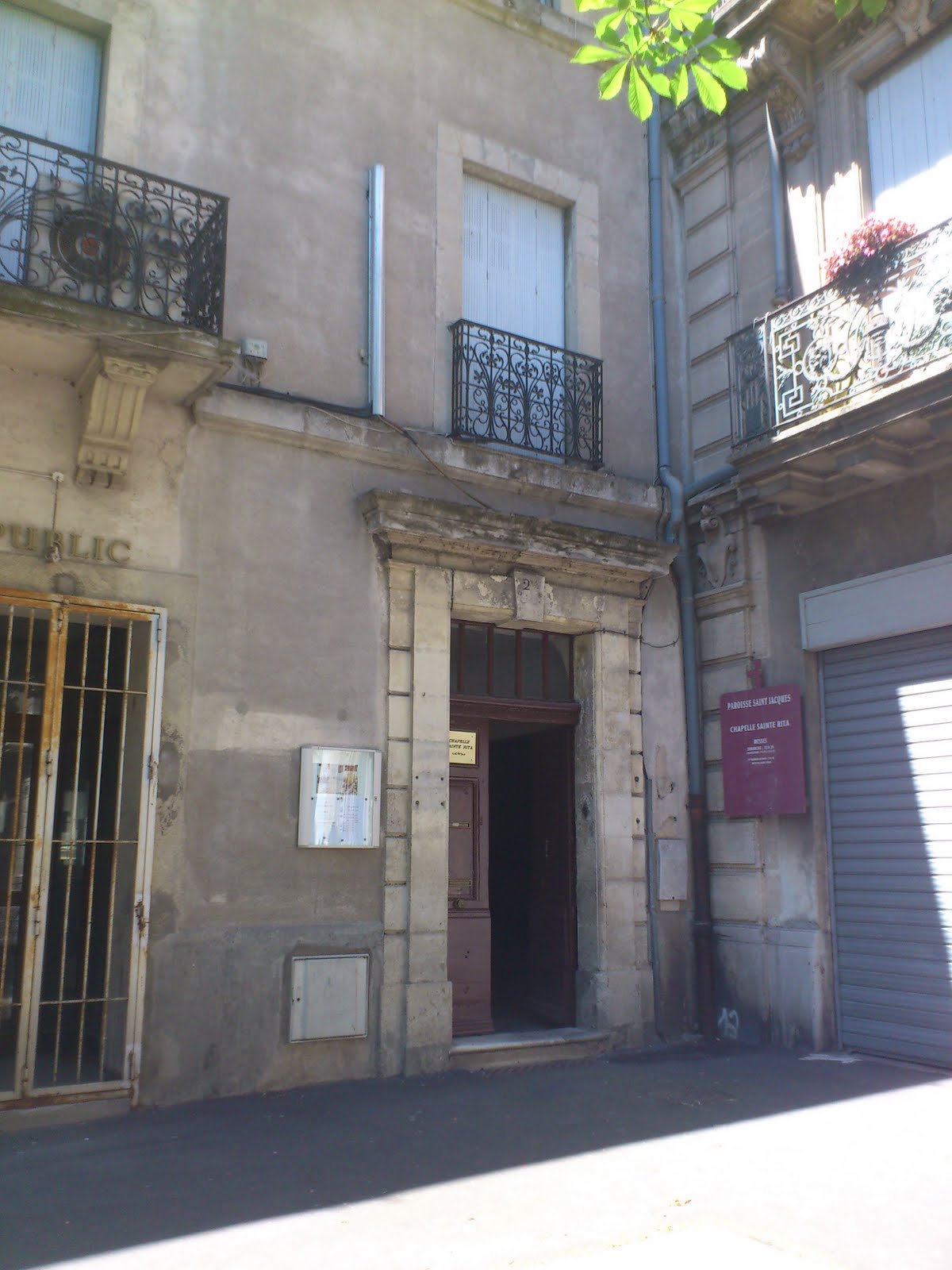
This is the doorway of 2 bis Pl. Garibaldi, Beziers (you can see it on the StreetView link above behind a large blue van that's in the foreground). Even an observant passer-by would spot very little to attract attention; and if such a passer-by were overtaken by curiosity and feel impelled to duck inside this particular doorway to see what he might find, he would discover an entrance hall like a hundred thousand others in French urban buildings, with an unremarkable staircase leading to appartments on the upper floors. Unless, that is, it was a Sunday or Holy Day.

On a Sunday or Holy Day our observer's eye would be led to an open pair of doors at the back of the entrance hall, leading into a large bright vestibule with a tell-tale statue of Saint Rita with votive candles lit before her at one end. If it was a Sunday or Holy Day he might also hear the pure strains of plainsong. Our traveller would have arrived at Chapelle Sainte-Rita: Bezier's best kept secret.


For the past 12 years the Extraordinary Form of the Mass has been prayed here every Sunday morning and every Holy Day. The chapel is devoted to the EF. Years before the Motu Proprio, a traddie-friendly Bishop gave permission for the older form of the Mass to be said here on a regular basis, and a new parish was born. Strictly speaking, it's a "parish within a parish" as the Chapelle is attached to the parish church next to the Cathedral and many parishioners attend their daily Mass there in the Ordinary Form. But what a parish - probably the youngest, most dynamic parish that I can recall: at 41 I felt like an oldie! Large families, new families, teenagers, young couples in their 20s, lots of babies, and a fair sprinkling of older and elderly parishioners as well. I'm used to parishes that pray the Extraordinary Form being far more demographically healthy than the average parish, but this group was positively thriving. The Parish Priest appears to have boundless energy and is wonderfully orthodox, having been ordained in 2005 by the Institut du Christ-Roi Souverain Prêtre, and it is wonderful to see his relationship with both young and old. He also turns out to be a friend of our local Parish Priest (in France) with whom we get on very well - another advocate of the Benedictine reforms. As a family we were welcomed to the Chapelle Sainte-Rita community as though we were long lost parishioners, and instantly invited to events, our eldest son invited to serve the following Sunday. The choir is wonderful, the chapel acoustics lovely. Can you tell that we're delighted?


We've found a true home from home in France, and I heartily recommend any devotees of the old rite looking for Mass in the western Herault to come to Chapelle Sainte-Rita in Beziers (2 Bis, Place Gambetta). There's a hidden pearl of great price behind that innocuous doorway.