Occasional dispatches from the front line of spiritual battle. A Catholic blog. Postings often conceived in the garden, at the playground or at the kitchen sink and hastily typed out far too late at night after putting the children to bed.
Blog started on the Feast of The Divine Mercy 2011, the day of the Beatification of Pope John Paul II. Blessed Pope John Paul II - Ora Pro Nobis!
Great video of this year's Saint Catherine's Trust Family Retreat. I cannot overemphasise the benefits, both spiritual and in terms of fun and fellowship, of this weekend to families. If you're even the slightest bit tempted to try it, or vaguely curious about the Traditional Latin Mass or keen to cultivate an authentic Catholic family culture, then pencil it in for next year!
There has been a flurry of traffic to my blog from google searches about Pope Francis in the few hours since his election was announced. I thought it interesting that two dominant patterns emerge:
Pope Francis / Bergoglio + "Neocatechumenal Way" / "Neocatechumenate"
Pope Francis / Bergoglio + "summorum pontificum" / "extraordinary form"
I think the truth is that as Pope Francis is unknown to most of us, many people are apprehensive about what the future may bring. The anxiety appears to be most acute among those who feel that their celebration of the liturgy may be under threat. The most sensible thing to do is to ignore the hysteria in the blogosphere and pray for our new Pope, for Holy Mother Church, for our priests and our bishops and for ourselves. I should take my own advice: I've been driving my husband mad with incessant pacing around the house, punctuated by web searches followed by more pacing throughout the evening and into the small hours.
Really, this anxiety is misplaced. The reform of the reform has gained its own momentum: think about the growth in traditional masses, communities and clergy in the last eight years. There is no reason to assume that anything will change with regard to Summorum pontificum, and so equally there is no reason to assume that the brick by brick reform will not continue to gain momentum. On the other hand, the former Cardinal Bergoglio has a track record as a staunch defender of natural law, having opposed homosexual "marriage", adoption of children by same sex couples, and abortion. He has shown that he is not afraid to confront secular authorities where moral issues are at stake. With homosexual "marriage" being promoted across the planet, and abortion being redefined as a human "right" by NGOs whist at the same time German Bishops approve the morning after pill, it could be that Pope Francis is a truly inspired choice, and that his own choice of name reflects his understanding of the enormity of the task ahead.
Listening to Edward Stourton's hatchet job Radio 4 programme "In search of the real Pope Benedict" I wondered whether the BBC would afford similarly slipshod journalism to another subject. Imagine coverage of the next Conservative conference commented on by spokesmen from Militant Labour, the Socialist Worker, the Fabian Society and, to show real "balance and fairness", Alan Rusbridger. Remember this next time the debate about the Licence Fee rolls around.
Hearing Tina Beattie shrilling her way though the programme was more than I could bear. It was a roll-call of dissenters, and could have been written by dear saved brother Eccles as a parody of "wot sum unsaved and unedykated pussons mite fink". Hubby and I stood in the kitchen in slight shock listening to the broadcast, neither of us recognising the descriptions of our beloved Holy Father, nor of the slant on the last eight years, which, if one we to believe the programme, had been one of utter devastation for the Church. "Why" my husband wondered "do all these people seem to think that the Church should be moving forwards? What makes them think that the Church should be 'moving' at all?" There's an odd modern orthodoxy that movement - or change - or progress - is by definition a good thing. It's an argument that has been used frequently in the debate about changing the definition of marriage, and is one that I suspect we will be hearing frequently from now on. It is used to build sophistic arguments that suggest that if one does not agree with a particular point of view, it is simply because one has not caught up yet with the inexorable tide of change. Thus Holy Mother Church is simply behind the curve when it comes to fashionable sexual and moral views, and will eventually "get with the times". There is no understanding that Truth is eternal and unchanging: this is utterly inconceivable to the modern thinker.
There is no doubt that political liberals who self-identify as Catholic (whilst rejecting all that the Church teaches) are running scared, and that is at the root of the current mania of Pope Benedict bashing. There is also no doubt that the father of all lies is gleefully doing all in his power to seed chaos and confusion: whilst we need to trust the Holy Spirit, we also need to storm Heaven with our prayers for not only a good Pope, but a good and holy Pope, and a good and holy Pope who will lead Christ's Church on earth with the same courage and determination shown by Pope Benedict XVI.
This Lent we have been given the gift of an immediately tangible and intelligible intention towards which our prayer and privations can be directed. Pray and fast, pray and fast.
Unusually, I have just spent a week away from connectivity - no Internet, mobile phone or other data connection: our family had travelled up to the Lancashire moors to celebrate my Grandfather-in-law's 100th birthday. We had a wonderful time, with family from all over the world coming to celebrate until...
...yesterday morning, For no discernible reason I felt an 'itch' to turn on the television. As we don't own a TV at home, this is quite unusual . We had been staying in rooms above a pub in the edge of the Lancashire moors, and my husband and children had gone off after breakfast to pick up my in-laws who were visiting from North America. I was tidying our room and suddenly decided on a whim to see whether or not the TV worked and just happened to switch on BBC News 24 to see images of our Holy Father broadcast live with the announcement that he had just made.
I'm not the first Catholic blogger to say that I was shocked. Shocked is probably the wrong word. Bereaved comes closer. While I understand on an intellectual level what Cardinal Arinze is getting at here
I think that everyone who heard the news has been affected in a profoundly personal way. I felt bereft. My first thought was "Holy Father, where should we go? What should we do?" I felt small and childlike and lost. Were is my father going? I dropped down to my knees and prayed a decade of the Rosary. I wondered: " Beloved Pope Benedict - our Holy Father - what will we do without you?"
I instantly remembered how I felt when I heard that Pope Benedict had been elected in 2005: ELATED. At the time I didn't know why, exactly, it was so important to me that he became Pope rather than any other - but I was already blundering towards traditionalism (blundering meaning that nothing else felt right, nothing else answered the questions that had been left unanswered by decades in the Novus Ordo) - and I had a deep sense that having the then Cardinal Joesph Ratzinger as Pope mattered.
Years on, I can confirm that it was a defining moment in my reversion to Holy Mother Church. Yes, I was already a Catholic "revert" but Pope Benedict defined and refined my faith through his encyclicals and books. I devoured them. I professed - and continue to profess - gratitude for his clarification of the position of the Traditional Latin Mass. When the Moto Proprio came out in 2007 I was primed and receptive. Hungry for spiritual nourishment, I asked my (then) pp whether we might have a monthly Traditional Latin Mass as there were several families in the parish who were very keen to have one. I was told that I was getting all the Latin I could expect in our Novus Ordo use of the Gloria, Agnus Dei and Sanctus from Mass VIII throughout the year. We had "some" Latin - what more could I want?
Indeed: how much Latin could anybody want? "Feed my sheep" said our Lord, and indeed. as a family, we were hungry.Starving. Both my husband and myself had come from nominally Catholic families. "Culturally" Catholic families, one could say. We had reverted from an agnostic / atheistic / lackadaisically Catholic point of view, towards an orthodox, traditionalist point of view. Pope Benedict XIV provided spiritual food for the last stages of that journey, and for that we will be forever grateful. He provided the signposts that gave our journey direction.
I was born in 1969. I received my First Holy Communion in 1978 with little or no catechises. I was confirmed in 1983 with even less catechises: I didn't even manage to have a saint's name for my confirmation name! (Priestly readers: is there any remedy for this?)
I returned to the Church I believe in large part due to the workings of the Holy Spirit. My husband and I were married and had our children baptised. We went to church every Sunday and Holy day of Obligation, and I often took the children on weekdays. We felt as though we were hungry. We were looking for more, and as well-meaning as it was, our Novus Ordo parish wasn' t giving us the spiritual food that we craved.
I mention this all to explain why I consider myself to be of the "Benedict XVI" generation. Sure, I was 35 when Cardinal Ratzinger became our Holy Father, but for me (and for many of my age and generation) this was a defining moment. Pope Benedict XVI was unambiguous about Church teachings. He directed us towards timeless Tradition and Truth and in doing so filled the spiritual chasm that had been an irritant since adolescence. I cannot be the only person who has felt this.
In real terms this affected our family. Over time we gravitated towards traditional devotions, such as a nightly Rosary and saying the Angelus at noon, and later the traditional Latin Mass. We later moved house so that we could be attached to a parish with a priest who supported us in our decision to home educate our children and who offered our family a parish with a rich and nourishing spiritual life. As a family we became attached to traditional spiritual devotions, and became immersed in a broader and richer spiritual life than we had access to in the pre-moto-proprio days. Certainly these aspects of Catholicism existed before the pontificate of Benedict XVI, but his encouragement certainly served as a catalyst for our family.
Do you remember where you were on 19th April 2005? I do. I was in my dining room, close to the kitchen door, and I heard BBC Radio 4 announce the outcome of the conclave. I remember punching the air. It felt so very important at the time, and I don't think I realised how important it actually was until much much later on.
I will never forget where I was sometime after 10:30 am GMT on 11 February 2013: I was in a rented guest room above a pub on the moors in Lancashire. There was no mobile or internet reception. I had turned on the TV news utterly randomly.
There has been much talk of the JPII generation. I consider myself to be of the BXVI generation: sure, I was born in the late'60s but I came "of age" spiritually under the guidance of our current Holy Father, Pope Benedict XVI. And for this reason I will forever be in his debt.
Thank you Holy Father. Thank you. thank you, thank you. May Almighty God always bless and protect you.
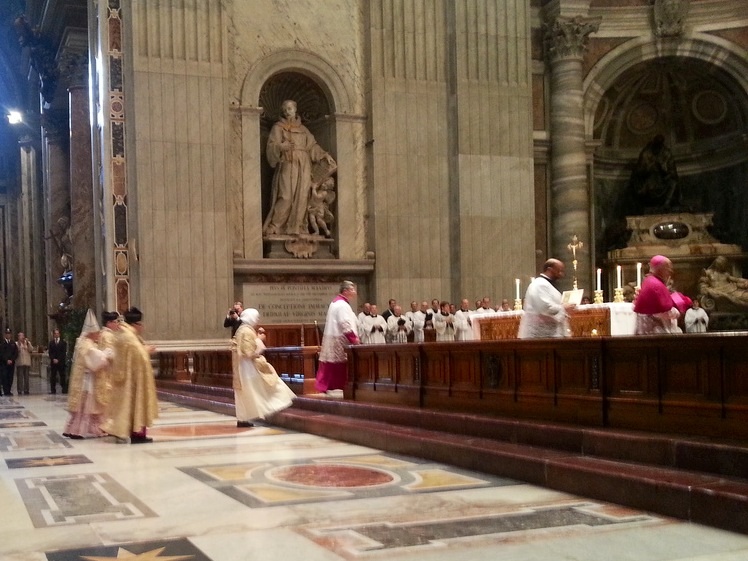
Here are some pictures of today's pilgrimage in thanksgiving for Summorum pontificum organised by the Foederatio Internationalis Una Voce. There have been Masses and traditional devotions organised in the run-up to today, but the Pontifical High Mass (Mass of the Immaculate Heart Of Mary) at the Altar of Saint Peter's Chair celebrated by Cardinal Cañizares Llovera, Prefect of the Congregation for Divine Worship and the Discipline of the Sacraments, is the high point of the Pilgrimage. The Holy Father granted a Plenary Indulgance (under the usual conditions) to the faithful who attended the Mass.
Following Adoration, the procession of Priests and Pilgrims leaves San Salvatore in Lauro
The Mass was, as expected, beautiful, reverent, and inspired great hope for the future of the traditional liturgy. There were hundreds of pilgrims: I calculated from a quick chair-count from the dome afterwards that, including those standing, there were probably almost a thousand people in the congregation. It was the usual healthy demographic mix that is so common at extraordinary form Masses everywhere: lots of young people - teens, twenties, thirties - in addition to young families and older people. It was - as EF Masses tend to be - racially mixed and with a visible number of disabled people as well. I mention this because the great irony of EF Mass congregations being perfectly "politially correct" in terms of demographic distribution when compared to the average parish, never fails to amuse me. Is anything more inclusive than the Universal Mass in the Universal Church in a universally understood language? I digress...
It feels as though Rome he been taken over by young traddie priests: the Borgo Pio is teeming with them, there were scores (I lost count) on the Sanctuary - it's wonderful and it's the future. As my husband pointed out, there were very few priests there older than him: the vast majority were in their 20s, 30's and early 40's (poor DH is in his mid 40s). We have run into several friendly and familiar faces: the famous Fr Z, Monseigneur Wasch of the incomparable ICKSP, and Fr Andrew Southwell from St Bedes, Clapham Park but currently clearly enjoying his sabbatical in the Eternal City.
Today started out with Exposition of the Blessed Sacrament at San Salvatore in Lauro followed by a procession through Rome to St Peter's Bascilica for the Pontifical High Mass in the Extraordinary Form celebrated by His Eminence, Antonio, Cardinal Cañizares Llovera, Prefect of the Congregation for Divine Worship. Winding through Rome's narrow streets, four abreast, while singing the Litany of the Saints was, frankly, amazing. We certainly amazed some restaurant patrons who seemed completely freaked out by the presence of a slowly moving procession of singing pilgrims; and that was before the scores of Biretta'd, cassock and cotta'd clergy at the end of the procession passed them by! The traffic was stopped for the procession at major intersections, and the whole of via della conciliazione was closed to allow the pilgrims to process towards St Peter's. I was profoundly grateful that the first memory my children will have of entering St Peter's Basilica will be with a procession of praying, singing pilgrims walking directly up the centre of Piazza San Pietro and through the central doors of the Basilica to the Cathedra
Petriand Bernini's amazing creation
"...designed to display
the chair on which, according to ancient tradition, St. Peter sat and
taught Roman Christians. Pope Alexander VII had the ivory-covered chair
put into the gigantic bronze cathedra, with the statues of the Doctors
of the Church, St. Ambrose and St. Augustine of the Roman Church and St.
Athanasius and St. John Chrysostom of the Greek Church. The religious
significance is extremely clear. The Doctors of the Church were always
consistent with Peter's teachings as they expounded theological doctrine.
The gospel does not
change because the Holy Spirit, portrayed as a dove flies along the span
of the centuries, assisting and accompanying its church. The chair or
cathedra of Peter symbolizes the perpetual continuity of the doctrine
and its promise of infallibility. It triumphed over all heresies throughout
the centuries."
It's been a long but spiritually nourishing day. I'm profoundly grateful to the Holy Father Pope Benedict XVI for Summorum Pontificum as participation in the Extraordinary Form of the Mass has brought many graces to our family - and it was evident today that we weren't the only ones. I spoke to pilgrims who'd come from Brazil to thank the Holy Father and show their fidelity to him. There I was thinking that we'd done well to get four young children to Rome from SE England; I was humbled by what I heard today: young and fit, our journey has been s doddle in comparison to so many who came from around the world.
I prayed for my readers, for other Catholic bloggers, for our priests, our seminarians, for friends and for family, Most of all I prayed for the Holy Father, that his generous liturgical vision continues
to bear fruit.
The procession crosses the Tiber towards Castel Sant'Angelo
The Roman traffic was stopped to allow the procession to proceed in dignity. It was a long procession, and some of those drivers will have been waiting for quite a while. Despite this there appeared to be good humour all around from bystanders, although some bewilderment on the faces of touists as the procession wove through the narrow streets near San Salvatore.
Coming home to Rome: the via della conciliazione was closed to traffic to allow the procession to pass. We gathered many pilgrims along the route: people were waiting for us to pass, others appeared to decide to join spontaneously. By my estimate there were at least twice the number of pilgrims arriving at Basilica di San Pietro in Vaticano than left San Salvatore in Lauro. We were about ten rows (of four abreast) when the procession left - by the time we arrived we were about thirty rows back!
Walking straight up to the centre door of Basilica di San Pietro in Vaticano
I was very happy that this was the way my Children entered St Peter's Basilica for the first time: through the front central door, praying and singing.
Pilgrims waiting for Mass to begin. The seating area in front of the Altar of the Chair of St Peter holds just under 500 people, and there were around 100 extra chairs to the right (I took photos of the seating area from the dome later on to confirm numbers of seats). All were filled and there were some people standing at the back. We estimated that there were almost a thousand people at the Mass.
We lost count of how many priests were on the Sanctuary, but we noticed the Benedictines, FSSP and the ICKSP.
His Eminence, Antonio, Cardinal Cañizares Llovera,Prefect of the Congregation for Divine Worship and the Discipline of the Sacraments
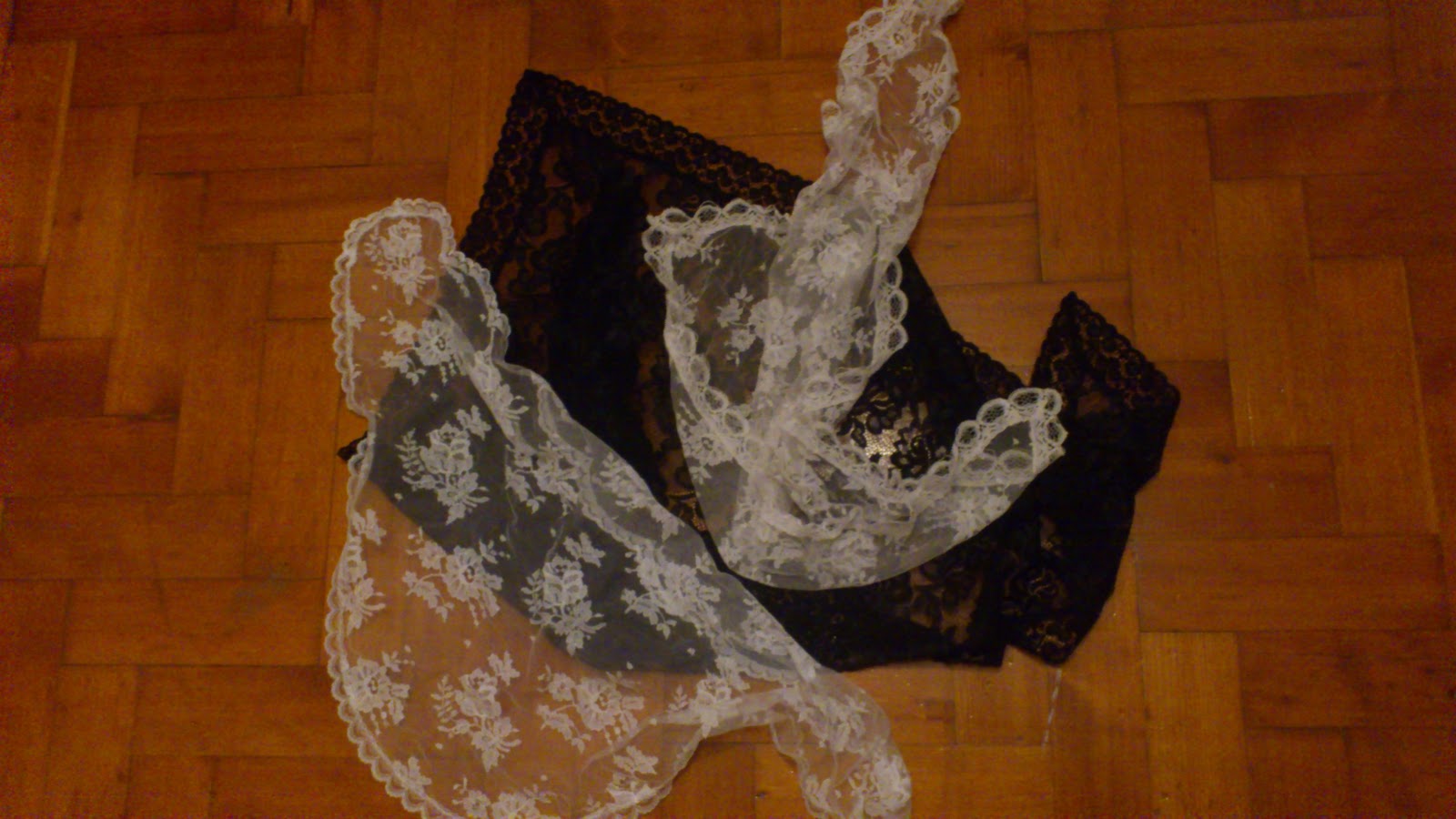
Somehow, somewhere our family has managed to lose three mantillas at church in as many months. It's annoying and puzzling in equal measures. I lose my red leather gloves, they turn up in the lost and found box. But three mantillas -- zoop! -- disappeared forever. Or have they? It's sort of like a lacy version of Schrödinger's cat. Mac suggested that I check the spare mantilla drawer, but no luck there either. Yes, I did say Spare Mantilla Drawer. How cool is that? Does your church have one? Nyah-nyah.
And speaking of cool -- well, just check this out. A parish like ours is worth any number of self-vapourising mantillas: perhaps it's fueled by mantilla power. I may stock up on a few extras just in case...
If you like your France à la Peter Mayle, then Béziers isn't the city for you: try Aix or St Remy or some of the pretty Luberon villages instead. There's nothing easy or gentle about Beziers: it rises jagged and arid above the vineyards of the Herault; life on its narrow streets slightly tinged by a shimmering heat haze of madness. It's a Babylon where North African, Gitane, French, Catalan, and Occitane words and dialects colour the local accent. It's beautiful but hard work; invigorating but tiring. In short: not the sort of place you'd expect to find a tranquil haven.
I should come clean here and admit that I'm a glutton for punishment when it comes to cities: many of my favourite places are those that don't instantly reveal their charms, the kind of place you either love or hate. I remember some 15 years ago a colleague at work almost spitting in indignation that anybody could possibly love that hot, noisy, rude city... Béziers. But I do.
Take a look at this link to Google maps: This is Place Garibaldi. Click on StreetView and do a 360' tturn on the spot. Remarkably unremarkable, it's in the heart of a commercial, predominantly Arab district - busy, noisy and dusty: a major arterial route through the centre of town. The narrow side streets have excellent small grocery shops that sell Raz-el-hanout and "maison" tagine spice mixes. Yum. But today we're not here for physical sustenance, rather something longer-lasting.
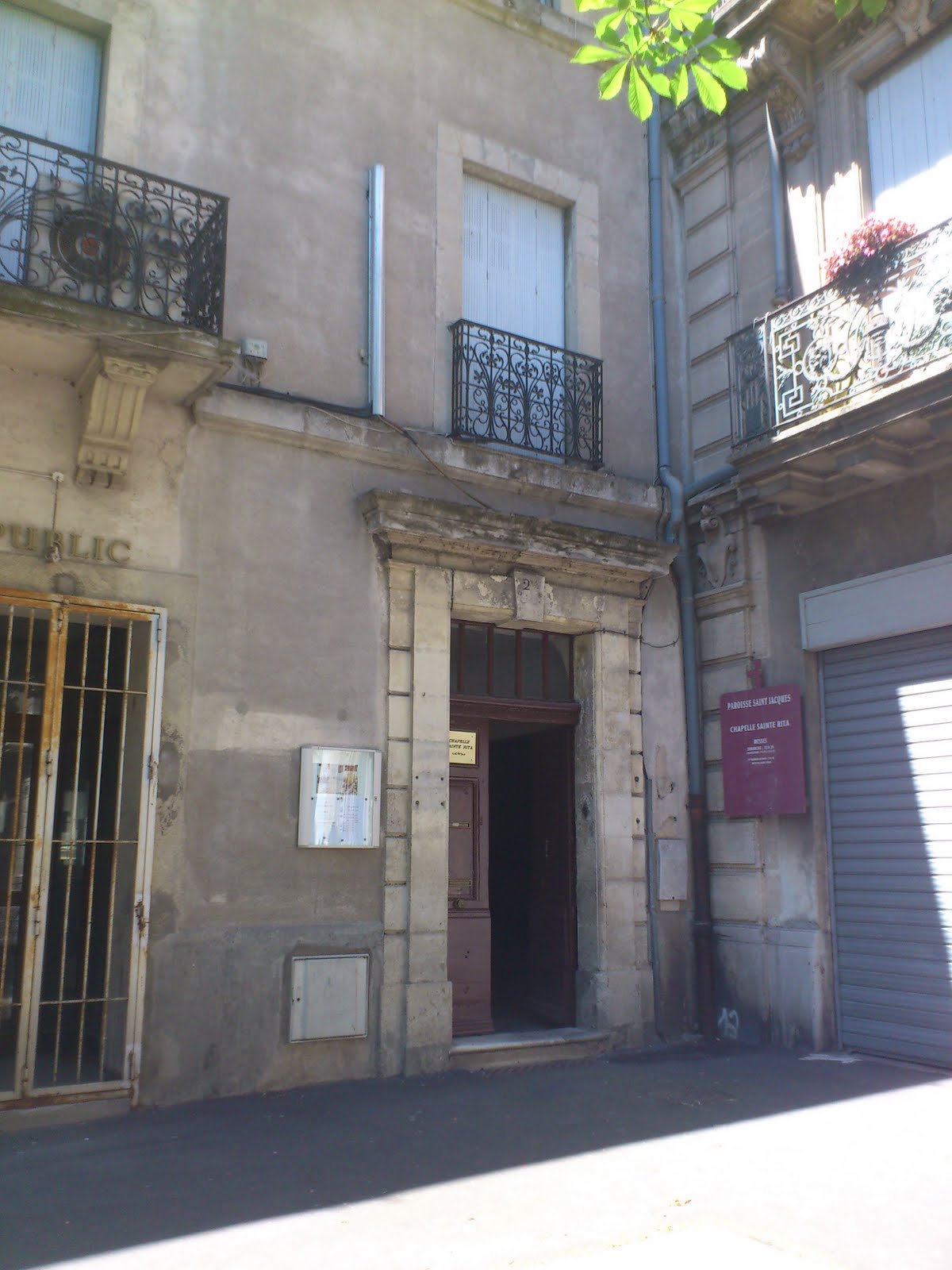
This is the doorway of 2 bis Pl. Garibaldi, Beziers (you can see it on the StreetView link above behind a large blue van that's in the foreground). Even an observant passer-by would spot very little to attract attention; and if such a passer-by were overtaken by curiosity and feel impelled to duck inside this particular doorway to see what he might find, he would discover an entrance hall like a hundred thousand others in French urban buildings, with an unremarkable staircase leading to appartments on the upper floors. Unless, that is, it was a Sunday or Holy Day.
On a Sunday or Holy Day our observer's eye would be led to an open pair of doors at the back of the entrance hall, leading into a large bright vestibule with a tell-tale statue of Saint Rita with votive candles lit before her at one end. If it was a Sunday or Holy Day he might also hear the pure strains of plainsong. Our traveller would have arrived at Chapelle Sainte-Rita: Bezier's best kept secret.
For the past 12 years the Extraordinary Form of the Mass has been prayed here every Sunday morning and every Holy Day. The chapel is devoted to the EF. Years before the Motu Proprio, a traddie-friendly Bishop gave permission for the older form of the Mass to be said here on a regular basis, and a new parish was born. Strictly speaking, it's a "parish within a parish" as the Chapelle is attached to the parish church next to the Cathedral and many parishioners attend their daily Mass there in the Ordinary Form. But what a parish - probably the youngest, most dynamic parish that I can recall: at 41 I felt like an oldie! Large families, new families, teenagers, young couples in their 20s, lots of babies, and a fair sprinkling of older and elderly parishioners as well. I'm used to parishes that pray the Extraordinary Form being far more demographically healthy than the average parish, but this group was positively thriving. The Parish Priest appears to have boundless energy and is wonderfully orthodox, having been ordained in 2005 by the Institut du Christ-Roi Souverain Prêtre, and it is wonderful to see his relationship with both young and old. He also turns out to be a friend of our local Parish Priest (in France) with whom we get on very well - another advocate of the Benedictine reforms. As a family we were welcomed to the Chapelle Sainte-Rita community as though we were long lost parishioners, and instantly invited to events, our eldest son invited to serve the following Sunday. The choir is wonderful, the chapel acoustics lovely. Can you tell that we're delighted?
We've found a true home from home in France, and I heartily recommend any devotees of the old rite looking for Mass in the western Herault to come to Chapelle Sainte-Rita in Beziers (2 Bis, Place Gambetta). There's a hidden pearl of great price behind that innocuous doorway.