Thursday, 29 September 2011

A Michaelmas miscellany


Holy Michael the Archangel is one of our family's favourite saints: the clue's in the blog title, really. St Michael is the patron saint of this blog. We have pictures of him in several places in the house which are comforting reminders that his aid can be invoked in time of need. We pray the "Saint Michael" prayer at least twice daily, and I like to think of Saint Michael poised to help us in our hour of need. He's traditionally been invoked in times of war, is the champion of warriors (including the spiritual kind, I have no doubt) and is usually pictured carrying the scales of judgement and often simultaneously casting Satan down into Hell.


Until I returned to the Church, "Michaelmas" didn't really mean much to me. I knew that it was the name of the first term at Cambridge (and the other place, apparently as well) but assumed that this was down to an old and long forgotten English folk tradition. Basically, I didn't have a clue. (That's where going to a heterodox Catholic school in the 1970s will get you!)
Later on I learned that St Michael is patron of the Church, especially called upon in times of great need or crisis; he is also the patron saint of the dying, of the holy souls in purgatory, of the Jewish nation, sick people, mariners, and grocers.  He is the Captain of the Heavenly Host, the fearless warrior angel who banished Lucifer to the depths of Hell; for this he has been known as the "love that conquers pride". 


Years later, I realised that Michaelmas wasn't just the feast of St Michael, but also of all the angels: the other two archangels mentioned in the canonical scriptures are Sts Gabriel and Raphael. No other angels are mentioned by name in the Bible.


Michaelmas is bound up with folk traditions: one of the most well known is that on his eviction from Heaven, the Devil supposedly landed in a bramble patch and spat upon the berries in his anger. This is why it's said that  blackberries are no good after 29 September, and why blackberry pie is traditionally eaten on this day (Quick! Use them up before the Devil gets them!). Goose is the meat traditionally eaten at Michaelmas in Britain, but I think that this may be a protestant addition as it supposedly dates back to Queen Elizabeth hearing the news of the defeat of the Spanish Armada whilst eating goose, and declared that goose should always be eaten on Michaelmas Day. Perhaps she was eating what was already a traditional meal for the day - does anybody know?


The Benedictine monastery at Mont Saint-Michel in Normandy was built by St. Aubert, Bishop of Avranches, and according to the legend, by direct command of the Archangel Michael himself, who appeared to the Bishop in a dream on three separate occasions. Some versions of the story  claim that the bishop ignored the Archangel's repeated requests until St Michael burned a hole in the Aubert's skull with his finger. Ignore an Archangel's request at your peril! 


If you have a waffle iron or waffle maker you might like to try this French recipe for "St Michael's Waffles". Obviously to keep it authentic you'll want to make a blackberry syrup to eat them with. Failing that, fresh blackberries (picked before today's feast) and whipped cream would be delicious as well.

GAUFRES
(St. Michael's Waffles)

2 eggs
1 egg yolk
2/3 cup sugar
1 1/3 cups flour
3/4-1 cup milk
4 tablespoons melted butter
1/4 teaspoon vanilla


Blend eggs and sugar. Add flour and milk alternately. Beat hard. Add butter and vanilla. The mixture is thin and should spread evenly on the preheated iron. If Gaufres tend to stick, butter both sides of the iron. Serve hot or cold. (thanks to Catholic Cuisine for the recipe)


St Michael's name is invoked four times in the Bible (all texts in full below): twice in the book of Daniel 10:13 and 12); IN the Epistle of Saint Jude where the Jewish tradition of a battle between Satan and Saint Michael over the body of Moses is alluded to (Satan attempted to dupe the Jewish people into the sin of hero-worship by disclosing Moses's tomb to them; Saint Michael had previously concealed the tomb to avoid subjecting the Jewish people to this temptation); and, probably most well known,  in the book of the Apocalypse when Saint Michael and his army of angels vanquish Satan and his demons - the battle at the end of time reflecting the battle at the beginning of time. Interestingly Jesus describes the fall of Satan from Heaven in Luke 10:18: "And he said to them: I saw Satan like lightning falling from heaven". Lucifer's fall from grace is described in Isaiah 14. 


Daniel 10:13 But the prince of the kingdom of the Persians resisted me one and twenty days: and behold Michael, one of the chief princes, came to help me, and I remained there by the king of the Persians. (Princeps autem regni Persarum restitit mihi viginti et uno diebus : et ecce Michaël, unus de principibus primis, venit in adjutorium meum, et ego remansi ibi juxta regem Persarum. )
 Daniel 12: But at that time shall Michael rise up, the great prince, who stands for the children of your people: and a time shall come, such as never was from the time that nations began, even until that time. And at that time shall your people be saved, every one that shall be found written in the book. ( In tempore autem illo consurget Michaël princeps magnus, qui stat pro filiis populi tui : et veniet tempus quale non fuit ab eo ex quo gentes esse cœperunt usque ad tempus illud. Et in tempore illo salvabitur populus tuus, omnis qui inventus fuerit scriptus in libro.)
 Jude: ...When Michael the archangel, disputing with the devil, contended about the body of Moses, he dared not bring against him the judgment of railing speech, but said: The Lord command you.(Cum Michaël Archangelus cum diabolo disputans altercaretur de Moysi corpore, non est ausus judicium inferre blasphemiæ : sed dixit : Imperet tibi Dominus. )
Revelation 12:7  And there was a great battle in heaven: Michael and his angels fought with the dragon, and the dragon fought, and his angels.  And they prevailed not: neither was their place found any more in heaven. And that great dragon was cast out, that old serpent, who is called the devil and Satan, who seduces the whole world. And he was cast unto the earth: and his angels were thrown down with him.(Et factum est prælium magnum in cælo : Michaël et angeli ejus præliabantur cum dracone, et draco pugnabat, et angeli ejus: 8 et non valuerunt, neque locus inventus est eorum amplius in cælo)


The Catholic Encyclopedia also says " According to the Fathers there is often question of St. Michael in Scripture where his name is not mentioned. They say he was the cherub who stood at the gate of paradise, "to keep the way of the tree of life" (Genesis 3:24), the angel through whom God published the Decalogue to his chosen people, the angel who stood in the way against Balaam (Numbers 22:22 sqq.), the angel who routed the army of Sennacherib (2 Kings 19:35)."


There are lots of recipes for St Michael's Bannock on the internet -- Bannock is a cakey bread traditionally eaten in Ireland and Scotland. Here's one that's easy and sounds tasty (we haven't tested it yet) from Our house of joyful noise


 St. Michael’s Bannock


Preheat oven to 375 degrees
Mix together:
2 cups of flour
2 tablespoons sugar
1/2 teaspoon baking powder
1/2 baking soda
1/4 teaspoon salt
Cut in 2 tablespoons butter (not margarine)
1 cup buttermilk or yogurt
handful of raisins or currants
On a floured surface, knead the dough until smooth, then pat into an 8 inch round loaf, and bake on a greased baking tray for 40 minutes... and enjoy!

... I think all this post is missing is the obvious:


Holy Michael, the Archangel, 
defend us in our day of battle. 
Be our safeguard 
against the wickedness and snares of the devil. 
May God rebuke him, we humbly pray; 
and do thou, O Prince of the heavenly host, 
by the power of God 
thrust down into hell 
Satan and all evil spirits 
who wander through the world 
for the ruin of souls. 
Amen.


Sáncte Míchael Archángele, 
defénde nos in proélio, 
cóntra nequítiam et insídias diáboli ésto præsídium. 
Ímperet ílli Déus, súpplices deprecámur: 
tuque, prínceps milítiæ cæléstis, 
Sátanam aliósque spíritus malígnos,
 qui ad perditiónem animárum pervagántur in múndo, 
divína virtúte, in inférnum detrúde. 
Ámen


Sancte Michael Archangele - defénde nos in proélio - Ora pro nobis!


Monday, 26 September 2011

Toddler catechism fail


We've been using the Baltimore Catechism at home with the children: it's so simple, and straightforward that even the youngest one picks up bits and pieces. As he's only two, we focus on the easy stuff like "Who made you? / God made you" and I thought that things were going well in his little head until...

...yesterday evening he toddled in from the garden with a smeared and dirty face, evidence of a feast in the blackberry bushes. "How did your face get so dirty?" I asked as I wiped his cheeks. The little brows furrowed for a moment, then he suddenly beamed and announced with the certainty of one who has learned his lesson well: "God make my face so dirty!"

I guess we still have some way to go...

Saturday, 24 September 2011

Every life has value

Twitch of the mantilla to Fiorella @ Monstrous Regiment of Women for this utterly inspirational video.


I'd love to know more about this young man's family. After watching this video I couldn't help but think about the baby at the centre of the successful $4.5 million dollar "wrongful birth" lawsuit in Florida. That baby was born with no arms and only one leg; his parents sued as had the ultrasounds been read correctly they would have aborted the baby because of his disabilities.

Given the current moral and ethical climate today,  I wonder whether Nick Vujicic would have been allowed to live, or whether his parents would have had to fight his corner against medical "advice". 

I think this video should be shared widely -- it's a wonderful rebuttal to the "quality of life" arguments put forward for aborting disabled babies. Equally importantly, I think that lack of familiarity with disabled people creates an environment where fear of the unknown panics mothers into aborting children with even minor disabilities. Seeing a person like Nick Vujicic living a happy, fulfilling life goes some way to redress the balance.  Please share this, and show it to your children.

Friday, 23 September 2011

Friday Menu ideas 2

No photo this time, I'm afraid, but a blissfully simple, very tasty meat-free meal that's scalable from a singleton portion to an extended family. I'm not even going to give weights and measures - just use common sense and make enough to satisfy however many you need to feed... This is also a great fall back as it's a store-cupboard recipe - you can keep everything (except the potatoes) on hand for when you need them. It comes from an American friend of mine: I think that Americans are really good at simple, tasty recipes of this kind. I used to be somewhat snooty about this sort of meal - made from tins from the larder; now I'm grateful for the time saved on days when I'd rather be doing something fun with my children than spending hours in the kitchen. I usually make this with milk or cream, but to get the full benefit of the American store-cupboard cooking it's best made with cream of mushroom soup.


Easy Tuna-fish pie

Ingredients: 
tinned tuna (drained)
sweetcorn (tinned or frozen; drained if tinned)
potatoes (mashed - with milk, butter, salt and pepper -- or however you like them).
cream of mushroom soup (tin)  - OR milk or cream
optional - grated cheese

Mix tuna, sweetcorn and soup (or milk/cream) in the bottom of a baking dish.
Top with mashed potato.
Sprinkle grated cheese on top, if you like that sort of thing.
Bake at a sensible temperature (say Gas mk 4 / 180C / 350F) for 20-30 minutes.
Enjoy with steamed green beans on the side, or a salad.

Thursday, 22 September 2011

Ban on "street prayer" fuels attack on pro-lifers


A French commentator has claimed that the recent French ban on "street prayer" was a critical factor last Saturday's attack on a peaceful pro-life protest in Paris. More than 200 pro-abortion militants from the Partie de Gauche attacked a small group of pro-life advocates who were protesting peacefully and legally outside a hospital that has recently resumed performing abortions (see the full story here). The pro-lifers, from SOS Tout-petits had to be protected by police who were forced to charge to leftist militants on two occasions in order to protect the group of seven pro-lifers praying the Rosary. The militants mocked the pro-life protesters, shouted blasphemous slogans, insulted the Blessed Virgin Mary and slandered the Catholic Church. They physically and verbally attacked protesters on several occasions; "it was pure hatred" said a witness. 


Eyewitness and photographer Anne Kerjean, writing on Nephtar et Nephtali, points out that the leftists have never before taken the risk of mounting a counter-demonstration until the ban on street prayers came into force. This view is supported by the call to action on the Partie de Gauche website which refers to SOS-Tout-petits as "Catholic fundamentalists" and, with reference to the proposed Rosary protest, declares that "the Partie Gauche reminds you that religion has no right to interfere in our secular republic and denounces the fundamentalists who attack women's rights."   Anne Kerjean writes that within a day of the ban on street prayer legislation, the Partie Gauche "demonstrated their cowardice by physically and verbally attacking a small group of men and women who were, thankfully, well protected by numerous policemen". 


She had intended to join the protest, but lost her way and, arriving late, was bewildered to find a large and belligerently aggressive crowd shouting pro-abortion and anti-Catholic slogans where she had expected to find a small, quiet group praying the rosary. Blending into the crowd she took photos, trying get a record of this unexpected event. As she came through the crowd she spotted a line of police officers in riot gear and realised that behind them were seven pro-lifers, quietly praying the Rosary. they looked frightened, and she exchanged glances and smiles of recognition with them. Unfortunately this gave her away as one of the "enemy" and she found herself physically attacked by leftists demanding that she give them her camera; she reports that she was grabbed, pushed and hit, and had several people trying to take her camera and backpack from her while screaming abuse. The police intervened and put her in the "safe zone" with the pro-life protesters; she was later escorted to safety alone by the police.She has put her photos of the event online, and has subsequently been inundated by abuse and threats from members of the Partie Gauche.


Another witness, Jean Vincent at Lesalonbeige, reports that there was originally a larger group of pro-life protesters but that they were split up by aggressive action by the Partie Gauche, leaving the group of seven "stranded" against the hospital railings - cornered (which is why they needed police protection). This second group were (deliberately) prevented from joining the rest of the pro-life group by the Partie Gauche extremists, but  managed were to pray the rosary unimpeded until the 4th decade when they were pelted with eggs by the pro-abortion group which then attacked them from two sides. The police were confused by the tactic, and the protesters were outnumbered more than 5 to 1. The priest who was leading the Rosary and several others were assaulted, thrown to the ground and beaten.
"It is one thing to disagree" writes Jean Vincent, "but to attack peaceful people, praying the Rosary, with a ratio of five to one is shameful". 


Anne Kerjean notes that the groups that had a "call to action" against the Rosary protest included Alternative libertaire, Les marxistes révolutionnaires, Le parti de gauche, L'Union Syndicale Solidaire, Le front de gauche, and Les anarchistes de Montreuil -- or as she puts it wryly "...feminists, transexuals, homosexuals ... and not there for a Techno-Parade -- they were all there for us!"


We saw extraordinary pictures recently from Madrid of warped protesters verbally attacking children praying in the public arena; last Saturday in Paris it seems that the public recitation of the Rosary was as much a motivator to the pro-abortion rainbow coalition as anything else. I've not commented until now on the French law banning street prayer because I've not been sure how I've felt about it. on one hand I sympathise with those who do not want roads provocatively taken over by Muslims on Friday afternoons: this is the supposed motivation behind the legislation. On the other hand, Christine at Laudem Gloriae makes the apt point that the new law could be just as easily applied to a Eucharistic procession or the Paris-Chartres pilgrimage. I think that it's essential that prayer remains in the public sphere, that prayer doesn't become something invisible, something that only happens behind closed doors between consenting adults. So what can we, the average pewsitter, do about this?  Here are a few ideas: say grace when you're out in public. No, it isn't rude or weird or antisocial. Nobody bats an eyelid when people raise a glass of wine in a toast; how much more important is making the sign of the cross, saying grace, and then making the sign of the cross again?! Over the years our family has grown in boldness with this: we used to only say grace if we were in a semi-public space -- having a picnic for example. Then we started saying it in restaurants, and now we say it everywhere. Nobody has ever taken offense -- if we're in a home where grace isn't said, we'll say "we usually say grace at home before a meal, do you mind if we do the same here?" Nobody has ever minded. My husband and I say grace before our meal when we eat out together; we don't flaunt it, but nor do we hide it. We just say it.  OK, perhaps somebody somewhere will think we're a bit odd, but more importantly it's a witness to our Faith, to Our Lord, and is a small sacrifice to make for all the good things that we've been given. 


I was recently at the Treasures of Heaven exhibition at the British Museum with a small group of families on a tour led by a priest. As there are many relics, including more than one relic of the True Cross, we were reminded that these are objects worthy of veneration, not simply "exhibits". Accordingly the priest led us all in adoration of the relic of the True Cross. It was humbling and powerful to kneel and pray in that secular space. I suspect that some people viewing the exhibition might have been a little taken aback, but I'd be surprised if anyone had been offended. I don't know if I would have had the courage to do that if I'd been at the exhibition on my own, but I felt that kneeling and praying before a relic of the cross on which Our Lord suffered and died provided both a powerful witness whilst buttressing  my faith. 


Public prayer can be awkward whether you're used to it or not. Human beings have a natural fear of ridicule, of looking silly, of contempt by our fellow humans. But here's a thought to bolster your courage: look at the photo at the top of this page. Next time you feel sheepish about saying grace in Starbucks or Pizza Express, just think about the seven frail elderly people praying the Rosary surrounded by a violent and baying mob. A few funny looks isn't much to put up with really, is it?

Wednesday, 21 September 2011

Neonatologist: fight against abortion reflects end of humankind

A French neonatologist involved in the pro-life movement has commented that  the fight against abortion is “eschatological,”, that is, a reflection of the end of the world, the destruction of mankind. LifeSite News reports Dr. Xavier Dor's comments which followed violent attacks by pro-abortion counter-protesters on a legal and peaceful pro-life protest outside a Paris Hospital which has recently re-started performing abortions. The pro-life protesters had to be defended by the police who were forced to charge the counter-protesters twice in order to prevent them harming the pro-life group. The pro-lifers, a group called, SOS Tout-petits (SOS Tiny-ones), managed to pray a complete Rosary under police protection before being escorted away by the police for their own protection. 


Dr Dor commented that the well organised and violent reaction to his group's protest shows how seriously the power of prayer is taken, even when only a few people gather to pray the Rosary for the victims of abortion - babies and mothers - as well as for those who participate in this evil. Apparently there have been no violent reactions to pro-life demonstrations by SOS Tout-petits in the last 12 years, but Dr Dor fears that things are changing. 


His comments remind me of what Mary Wakefield wrote in the Spectator a couple of weeks ago about the change in social attitudes towards abortion : "that abortion is not just a necessary evil, but a jolly good thing. That being pro-choice no longer means just accepting that a woman has a right to decide, but that abortion must be celebrated and all doubters deemed religious nut jobs". This sort of attitude gives protesters a perverse permission to attack pro-life demonstrations as the pro-lifers are seen as "beyond the pale", expressing socially unacceptable opinions. The debate about abortion is changing - the pro-abortion lobby is finding it harder to make any argument based on logic or science (there aren't any), and has to resort to subjective  "rights" and "choices". This makes the pro-abortion reaction "personal" and emotional. I hope and pray that we do not see scenes like those in Paris here in London. Given the current disproportionate bias against Christian belief in the public sphere, I wonder whether our police would protect the legal pro-life protesters or see them as trouble-makers and ask them to move on?


Tuesday, 20 September 2011

I never thought I'd like a bouncy-castle church...


...but this inflatable church, made in Poland to be used in Russia is absolutely brilliant! Father Krzysztof Kowal the Catholic parish priest of Petropavlovsk-Kamchatsky in the far East of Russia had requested permission to build a Catholic church in the area but had been turned down repeatedly by the uncooperative local government. A novel solution was proposed by a Polish friend, Robert Wojcik, whose usual business is  building inflatable toys for children in Kolobrzeg, Poland. Wojeck created an inflatable gothic-style chapel, weighing 100 pounds and easily transportable. Being a temporary structure and inflatable means that Fr. Kowal can dodge the planning restrictions that have thus far thwarted his efforts. The inflatable chapel will be the first Catholic church on the Kamchatka Peninsula. 


"This is a real Gothic structure which stirs a lot of interest. Many people are unaware that there is a Catholic priest in the city, as there is no real Catholic church; and when we get together at home people think we are some kind of a sect," the priest said. Before the arrival of the inflatable church local Catholics gathered in homes, hotel rooms or outdoors near rivers or lakes for Mass. Because the inflatable chapel is portable Fr. Kowal will be able to move it to suit the needs of his congregation in the winter months when the weather is often -40'C. I can only guess that there aren't many Catholics in the region, as the inflatable church appears to be tiny.


Clearly this isn't an ideal scenario -  you can only imagine the potential for abuse in the wrong environment - but the various news reports about this consistently point to a local government unwilling to allow the construction of a Catholic church, simply because it is a Catholic church. This isn't an unusual situation in Russia -- two days before the inflatable chapel arrived in Kamchatka, a chapel boat carrying the relics of eight saints began a voyage down the Volga in an attempt to reach communities where there is no church. The chapel boat is an ecumenical project between the Catholic Church and the Russian Orthodox Church and carries the relics of John the Baptist, Anne, Bartholomew the Apostle, the martyrs Stephen and Lawrence, George, John Chrysostom and Cyril, the missionary to the Slav people, all of whom are important to both Churches. The relics are a gift from the Catholic Church to the Russian Orthodox Church, and the boat has been paid for by Aid to the Church in Need who help the persecuted church with both practical and spiritual aid. Help them to help priests like Father Kowal.


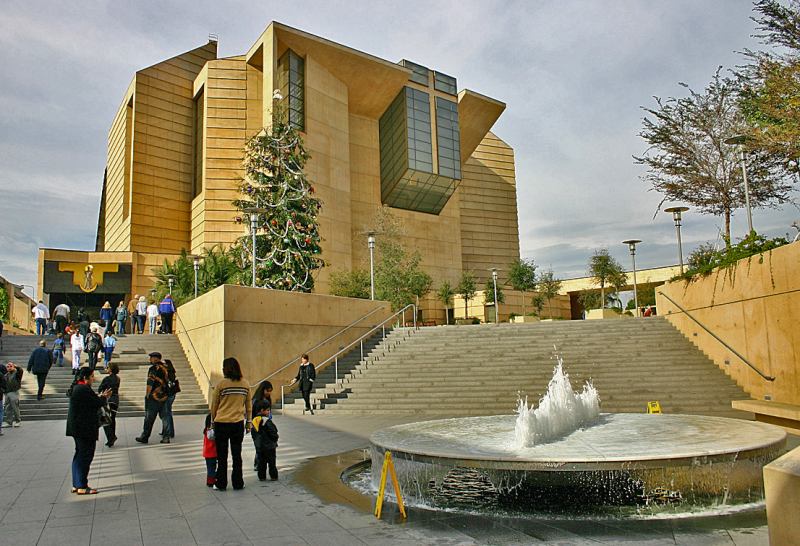
Hopefully the publicity generated by this story - and by Father Kowal's novel solution to bureaucratic intransigence - will encourage the authorities to allow the construction of a dignified, permanent church for the Catholics of the Kamchatka Peninsula. Things could be much worse -- and much more expensive: an inflatable church might not be your cup of tea, but at least it looks like a church unlike this


or, closer to home, this.


Photo Credits: AsiaNews.it (inflatable church),  and Wikipedia (Liverpool and LA Cathedrals)